Texas dispute resolution guide
How to appeal a denied Texas workers comp claim
Texas does not decide a disputed workers’ comp claim in one hearing. A denial travels through a benefit review conference, a contested case hearing before an administrative law judge, and an appeal to the Appeals Panel — each with its own forms, filing addresses and 10- to 90-day deadlines. Here is the whole path, in the order the division runs it.
The short answer
- Texas resolves benefit disputes in three administrative steps: a benefit review conference (BRC), a contested case hearing (CCH) before an administrative law judge, and an appeal to the Appeals Panel. Judicial review in district court comes after the panel.
- The dispute usually starts with a carrier notice — PLN-1 for a denial of compensability, PLN-11 for a disputed issue. You ask for the BRC with DWC Form-045 (Form-045M for medical fee disputes, Form-049 for medical necessity disputes), or ask to go straight to an expedited hearing.
- Two clocks decide most cases: the first valid certification of MMI and impairment rating becomes final unless you dispute it within 90 days, and an administrative law judge’s decision must be appealed to the Appeals Panel within 15 days.
- Exchange evidence on time. Pertinent information reaches the other side before you request the BRC and the division 14 days before it; hearing documents are exchanged within 15 days of the BRC, and late evidence can be excluded.
- The Appeals Panel reviews the record without a hearing, can reverse and render, reverse and remand, or affirm, and will not consider a late appeal or response.
Source video
Dispute Resolution: The Who, What, When, Where, Why, and How | CompCourses
Texas Department of Insurance, Division of Workers’ Compensation (TDI-DWC) — CompCourses webinar
Screenshots are frames from the webinar above and are taken only from its full-screen slide segments; none of the studio or interview footage of the presenters is used, and the programme mark on the section slides has been removed. The written steps are our own. Form numbers, the filing addresses and the exchange deadlines were cross-checked against the TDI-DWC benefit review conference page, which also states the 10-day and 14-day exchange rules and the three-day filing option before a BRC: www.tdi.texas.gov/wc/idr/brc.html
How to appeal a denied Texas workers comp claim, step by step
Fourteen steps, from the carrier’s denial notice to district court. Every screenshot is a still from the source webinar and links to the exact second it was taken.
- 1
Know the three administrative steps before you file anything
Texas settles workers’ compensation benefit disputes inside the TDI Division of Workers’ Compensation hearings section, and the administrative path has three stops: a benefit review conference (BRC), a contested case hearing (CCH) before an administrative law judge, and finally an appeal to the Appeals Panel. The BRC comes first and is where many cases end. Only issues that were raised at the BRC and not resolved there move on to a CCH, and only the judge’s written decision can be appealed to the panel. If the panel does not write a decision, its determination letter makes the judge’s decision the final decision of the division.
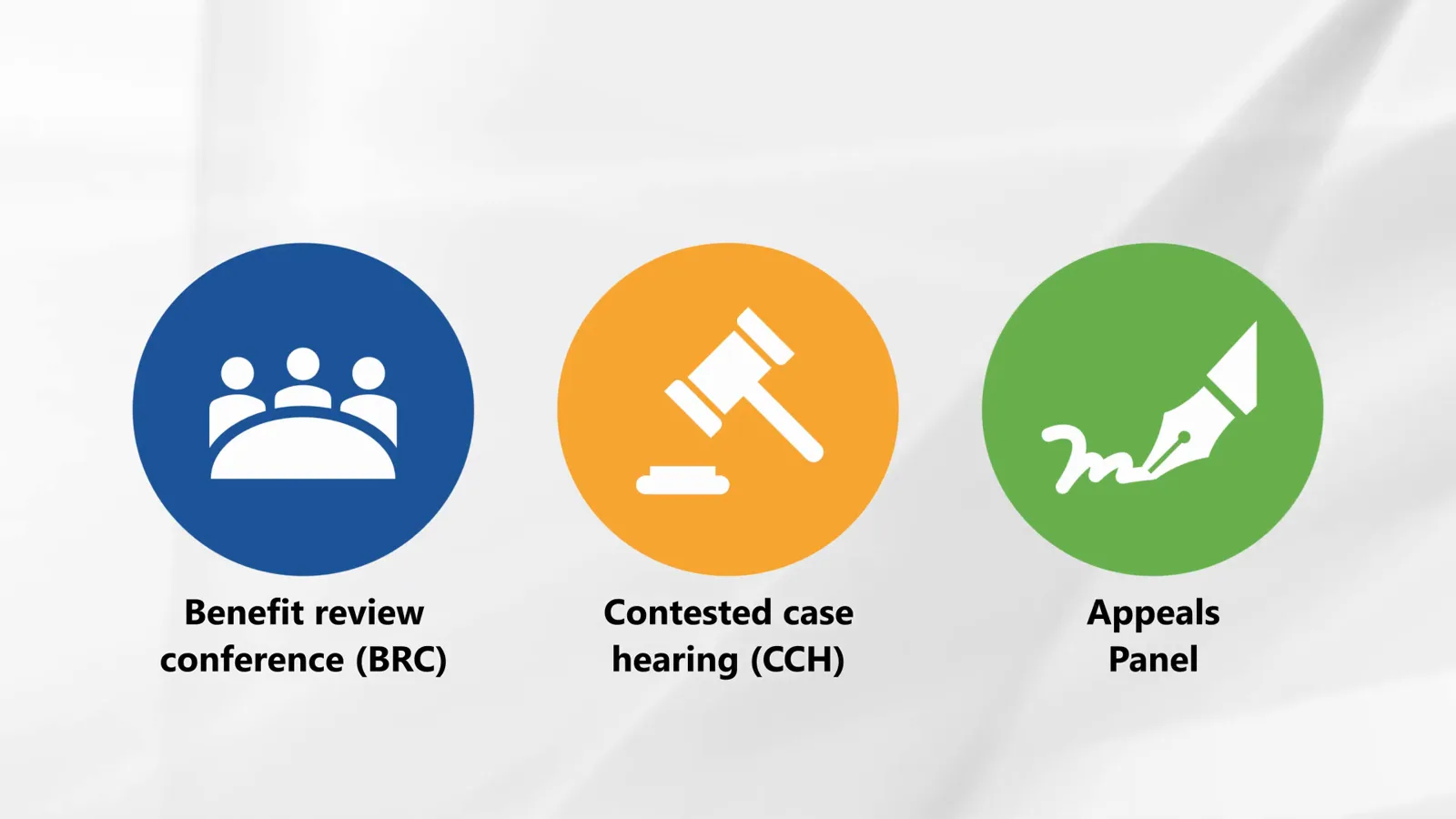
Three stops, in this order: BRC, CCH, Appeals Panel.Watch at 4:25 - 2
Check that you are a party who can bring the dispute
Injured employees, legal beneficiaries, insurance carriers and subclaimants — usually providers or health insurers chasing unpaid bills — can all bring a Texas workers’ compensation dispute. Employers are parties in one narrow situation only: the carrier has accepted liability for the injury and the employer wants to contest whether the injury is compensable at all. If a carrier has denied your claim or cut off a benefit, you are the party who files, and you do not need your employer’s permission or your employer’s help to start the process.
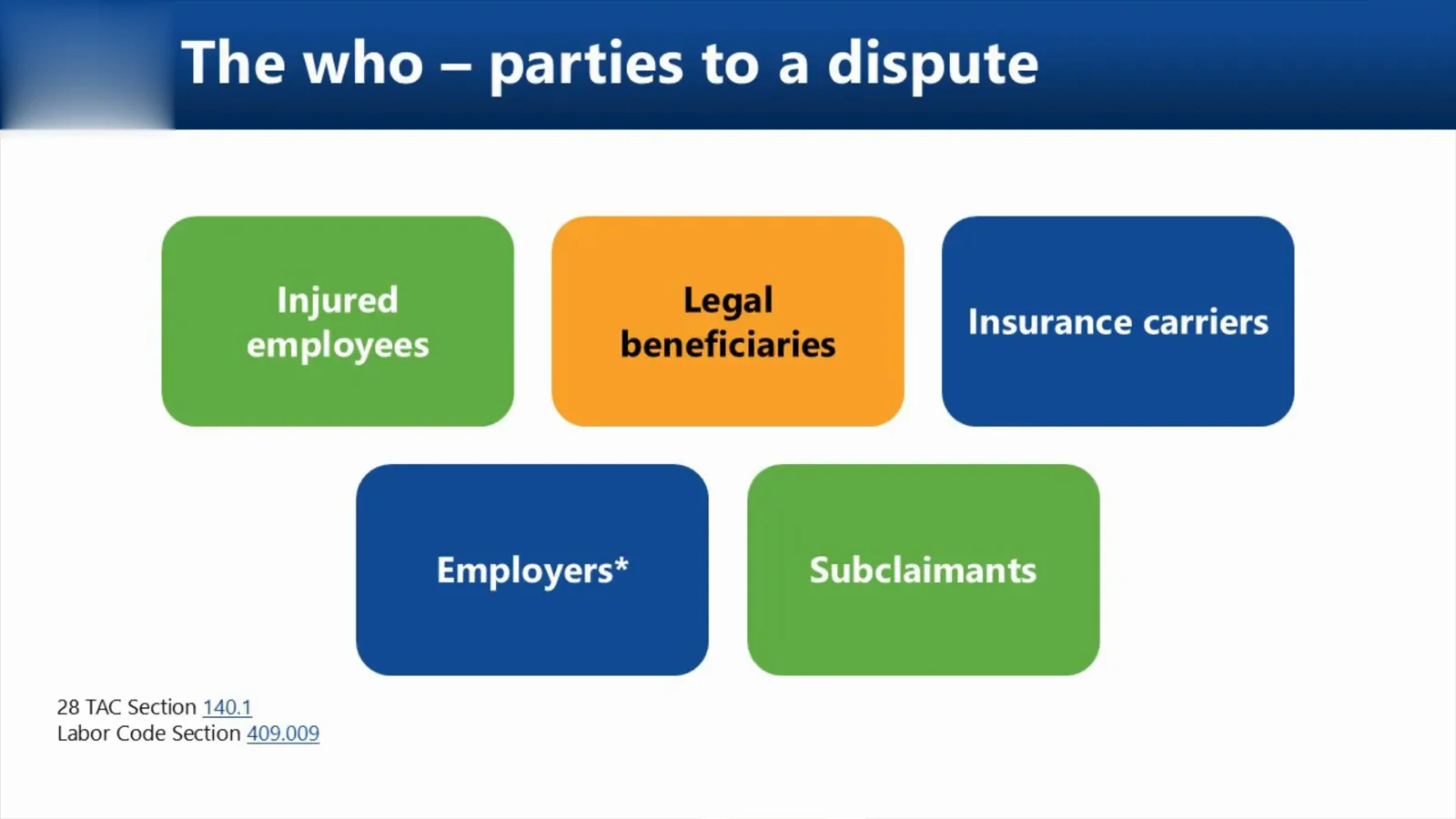
You can file without your employer’s help.Watch at 8:48 - 3
Read the PLN-1 or PLN-11 notice that starts your clock
A denial arrives as a plain-language notice from the carrier. PLN-1 is the notice of denial of compensability or liability: it tells you the carrier is not paying income or medical benefits for the claimed injury. PLN-11 is the notice of a disputed issue — disability, extent of injury, or death benefits. Both must explain the reason for the dispute in ordinary words, and the webinar’s examples show the standard formula with the carrier’s name filled in and the reason spelled out underneath. Keep the notice, because the date printed on it anchors most of the deadlines that follow.
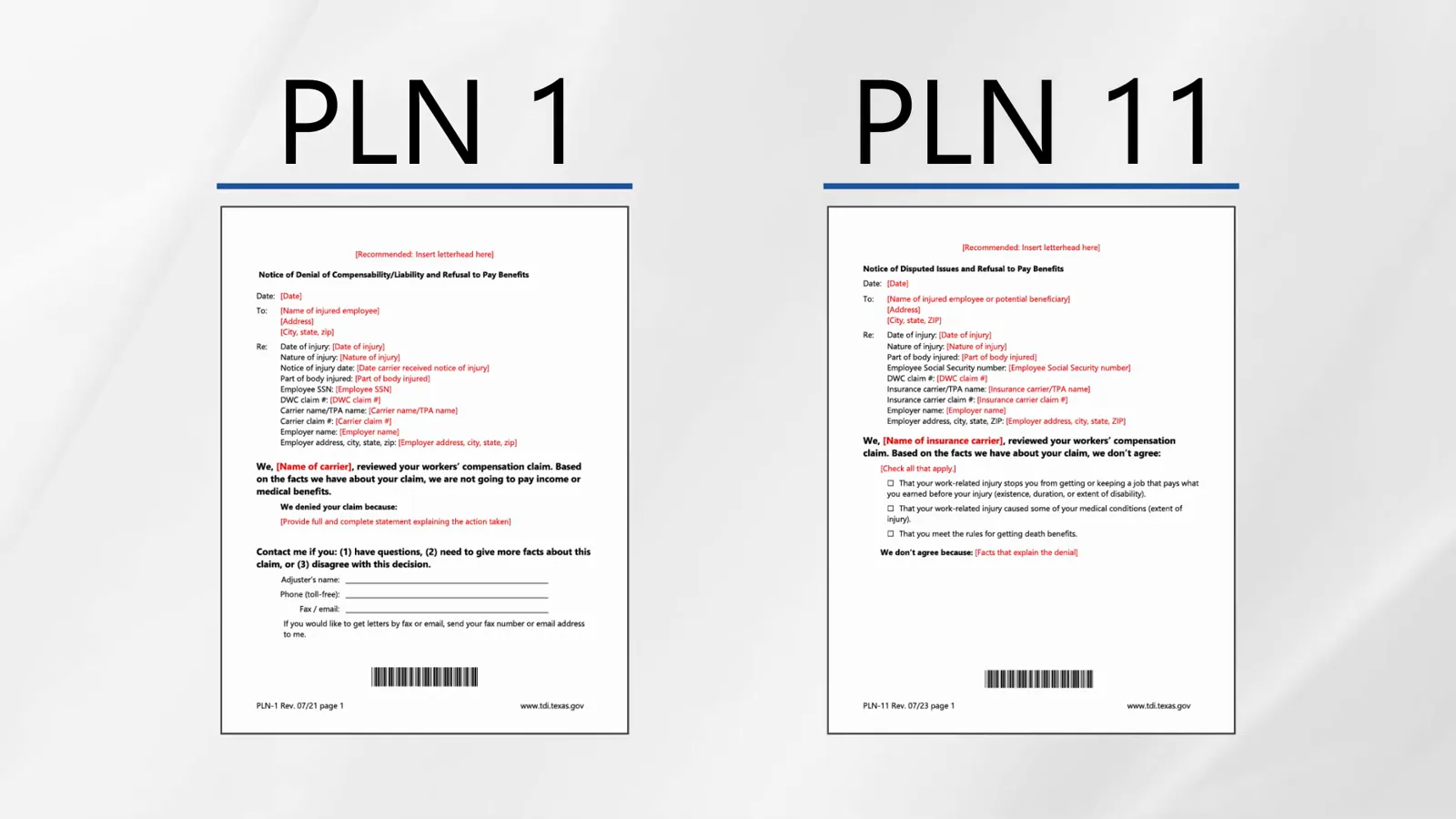
The denial is a dated form, not a phone call.Watch at 11:27 - 4
Name the disputed issue the way the division names it
Most Texas hearings disputes turn on a short list of issues: existence of a compensable injury, compensability of an occupational disease, date of injury, timely reporting of the injury to the employer, extent of injury, intoxication, disability and its duration, maximum medical improvement, impairment rating, 90-day finality, and supplemental income benefits. The three seen most often are extent of injury, MMI and impairment rating, and extent of injury is the threshold issue the other two flow from — which is why a denied condition so often ends up in dispute. Write the issue in the division’s own words so your request is not sent back for clarification.
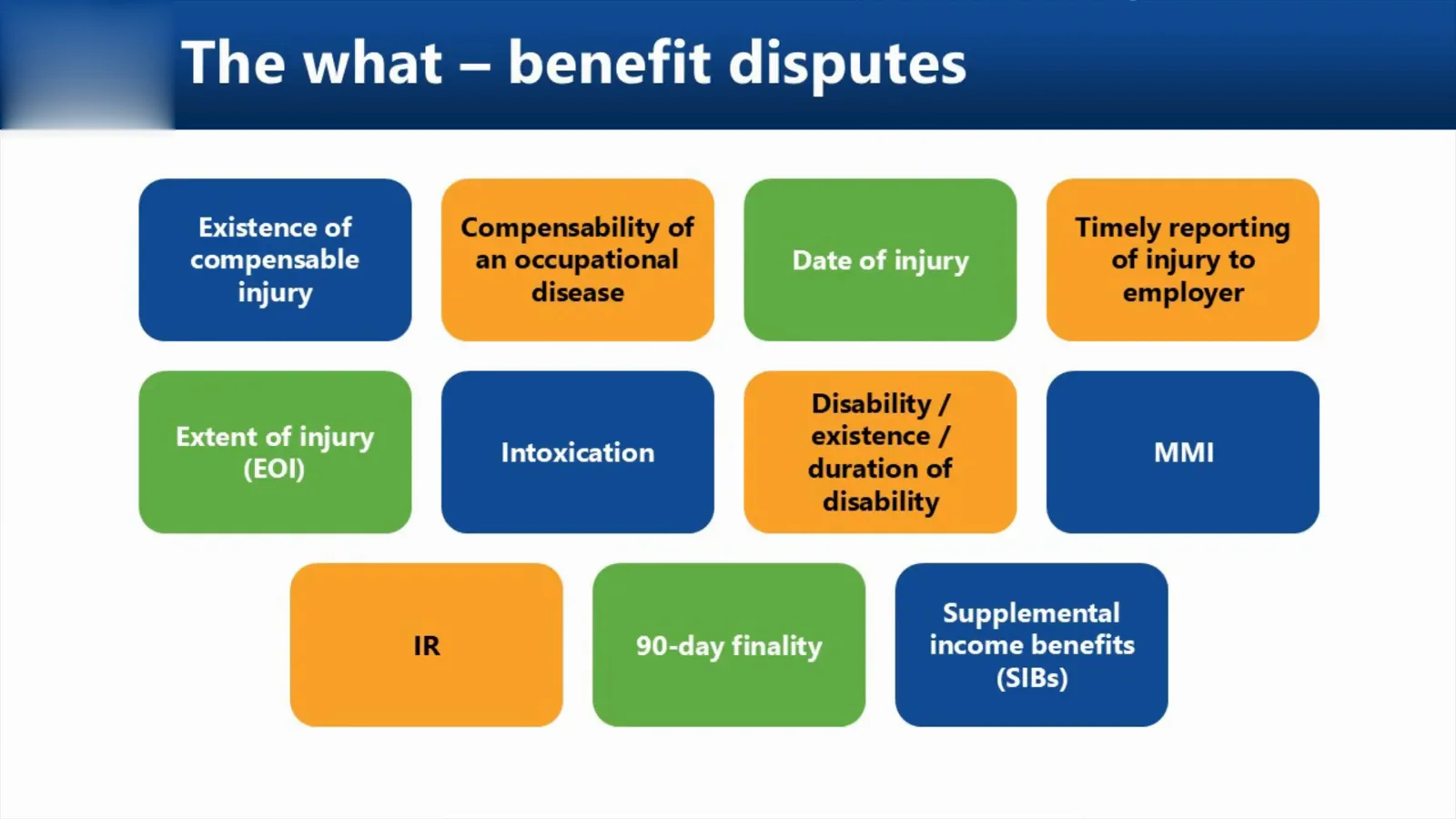
Say the issue in the words the division uses.Watch at 13:37 - 5
File the right form: DWC Form-045, Form-045M or Form-049
Where a dispute begins depends on the issue. DWC Form-045 is the request to schedule, reschedule or cancel a benefit review conference, and it is the form for a benefit dispute. DWC Form-045M asks for a benefit review conference on a medical fee dispute. DWC Form-049 requests a medical contested case hearing on a medical necessity dispute after an independent review organisation decision. A party may also ask to skip the BRC and proceed directly to a contested case hearing — an expedited hearing — when the issue is really a legal question or mediation has no chance of settling it.
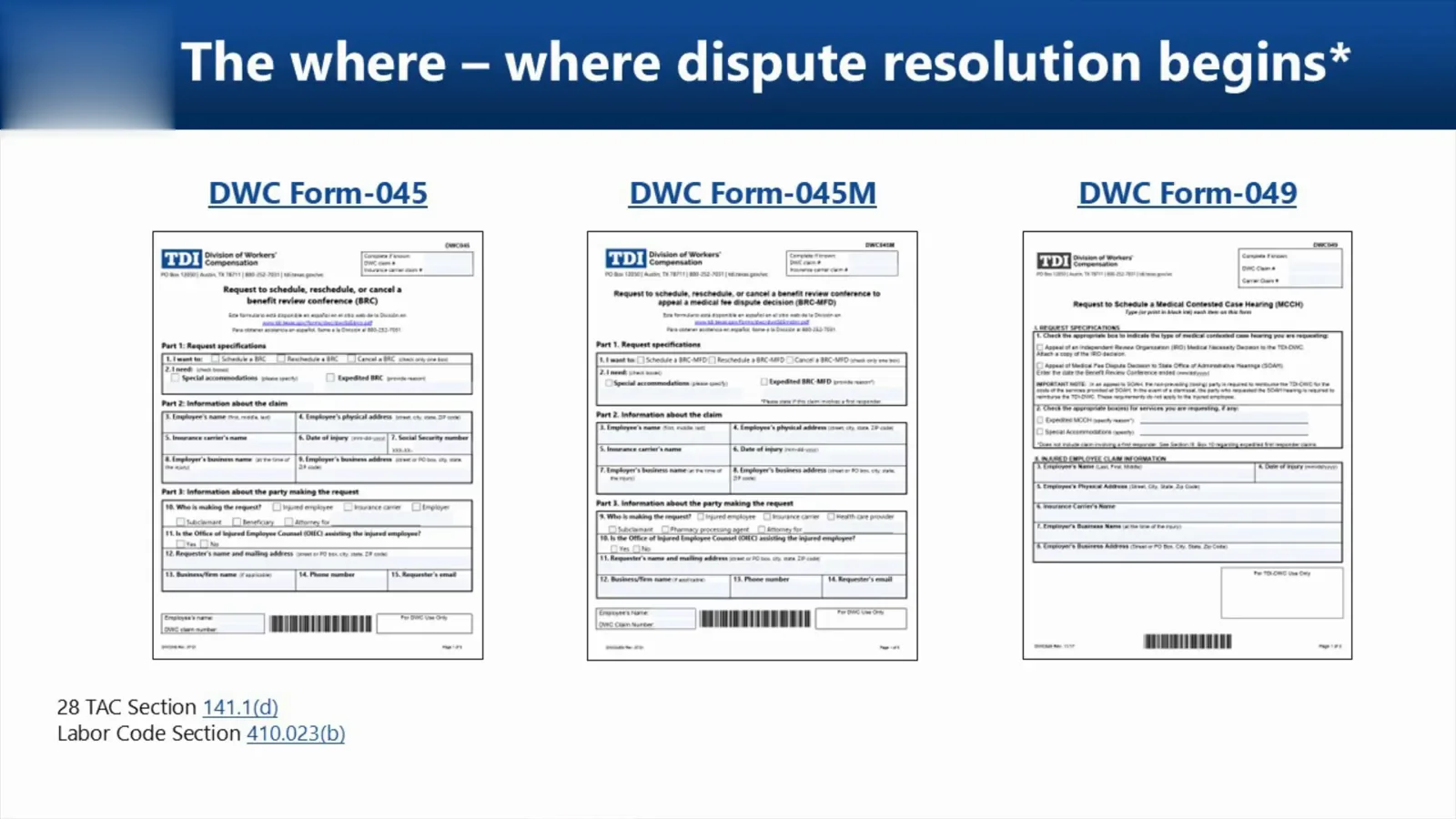
Benefit, medical fee and medical necessity disputes each have their own form.Watch at 15:15 - 6
If the BRC settles, the deal is written on DWC Form-024
A benefit review conference is an informal, non-adversarial meeting. You attend with your attorney or an ombudsman and sit down with a representative of the carrier and a DWC benefit review officer who mediates the dispute; the employer is not required to attend unless it filed the dispute, and no record is made. If the parties reach an agreement, the officer helps them put it on DWC Form-024, the Benefit Dispute Agreement: the docket number, the date of injury, a table listing each disputed issue with its resolution beside it, and signature lines for the employee or beneficiary, the employer, the carrier and an authorised DWC employee. Once signed and approved under division policy, that agreement is binding on the issues it covers.
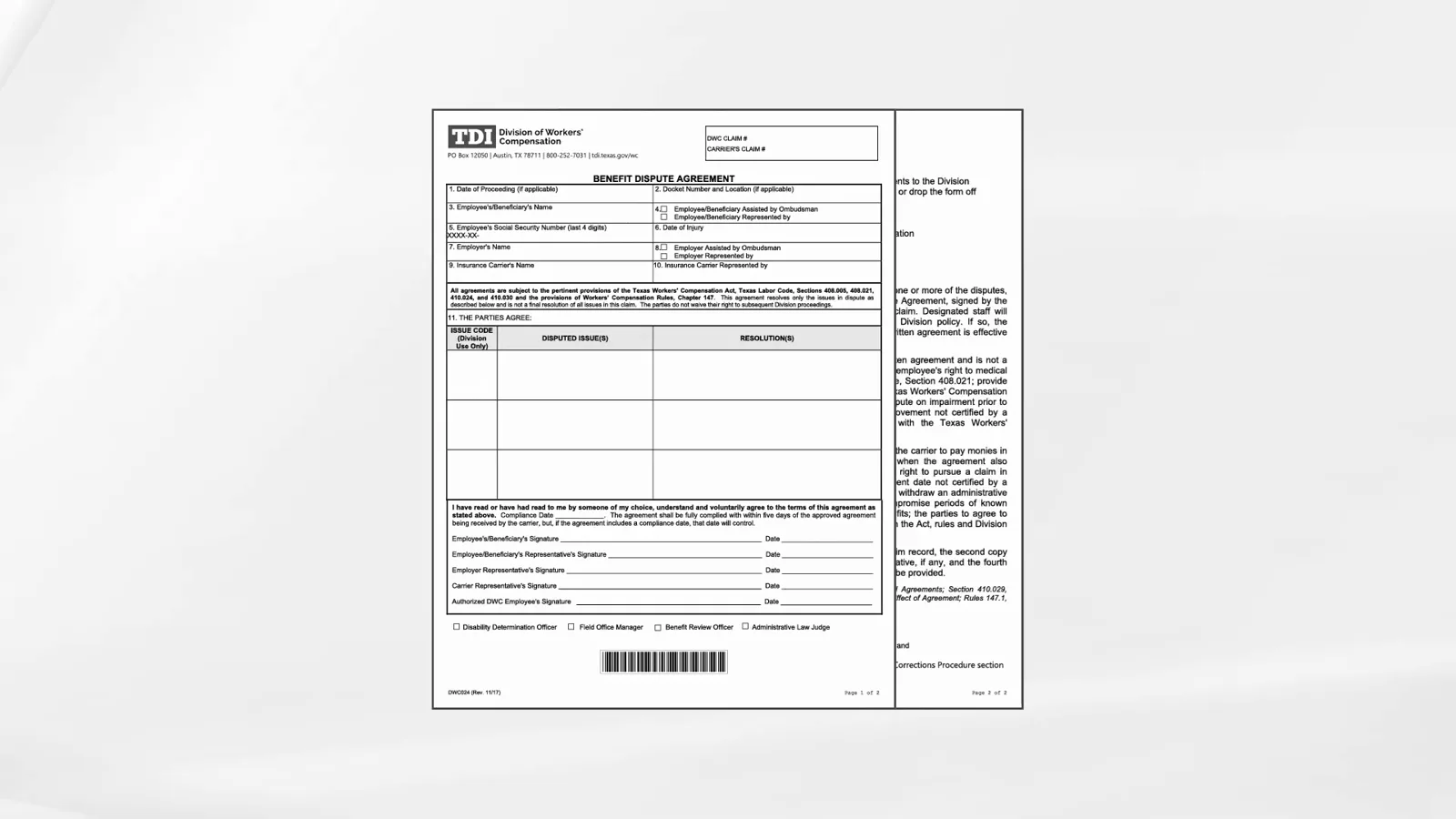
One page: the issue, the resolution, four signatures.Watch at 16:18 - 7
Send and exchange the pertinent information before the BRC
Pertinent information means everything relevant to the disputed issues, and it moves in a fixed order. You send the other parties a copy of it before you request the BRC. The other side then has 10 working days after receiving the request to send anything additional. No later than 14 days before the conference — five days if it is expedited — both sides send DWC everything not already provided and exchange whatever is left. Between parties, mail or fax or email is fine. With the division, the channels are email to [email protected] (with an underscore between BRC and Exchanges), fax 512-804-4011, mail to Texas Department of Insurance, Division of Workers’ Compensation, Hearings, Mail Code HRG, PO Box 12050, Austin, TX 78711-2050, or secure file transfer.
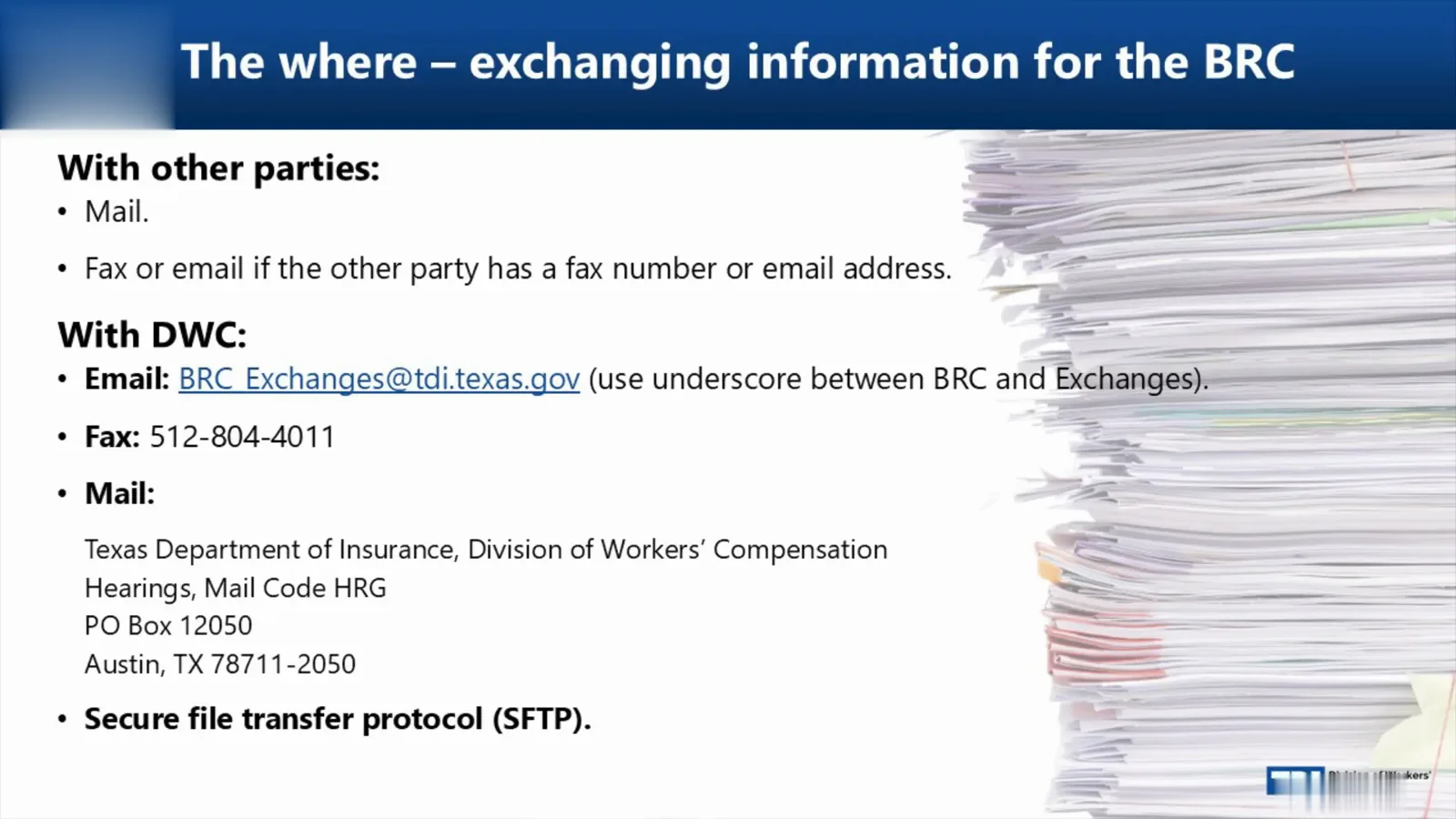
Email the division, then serve the other side.Watch at 17:38 - 8
Know what counts as evidence at the contested case hearing
A contested case hearing is formal and adversarial — the webinar compares it to a bench trial without a jury. An administrative law judge swears in witnesses, receives testimony, allows examination and cross-examination, accepts documentary exhibits and hears argument, then files a written decision within 10 days after the hearing closes. That decision is effective and binding on the date the judge signs it. What the judge weighs: witness testimony under oath, expert medical causation opinions, designated doctor reports on extent of injury, MMI and impairment rating, certifications of MMI and impairment rating from treating, referral and required medical examination doctors, plus peer review reports and medical records.
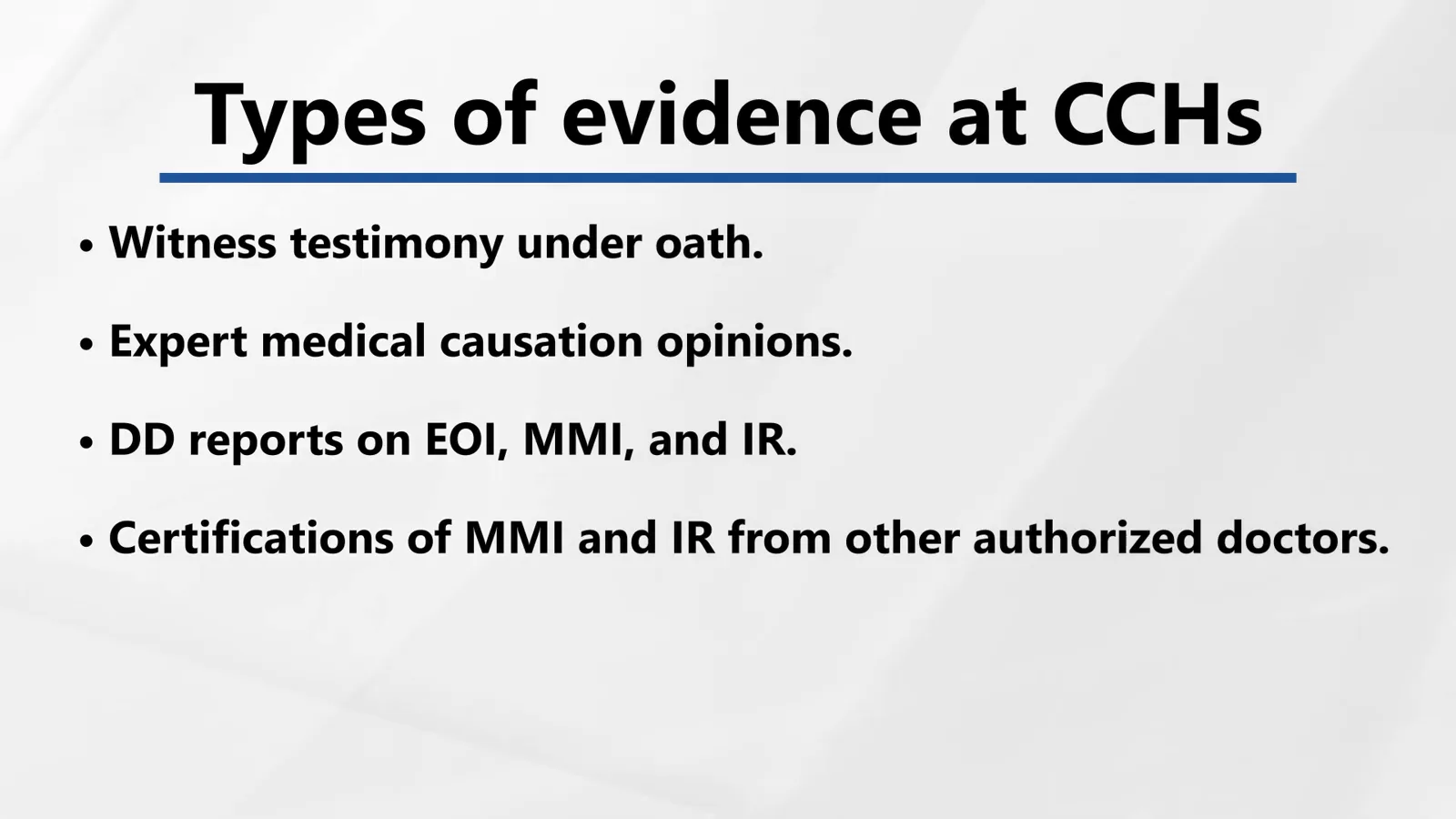
Not a court trial, but the judge rules on the record.Watch at 19:18 - 9
File your exhibits with the division before the hearing
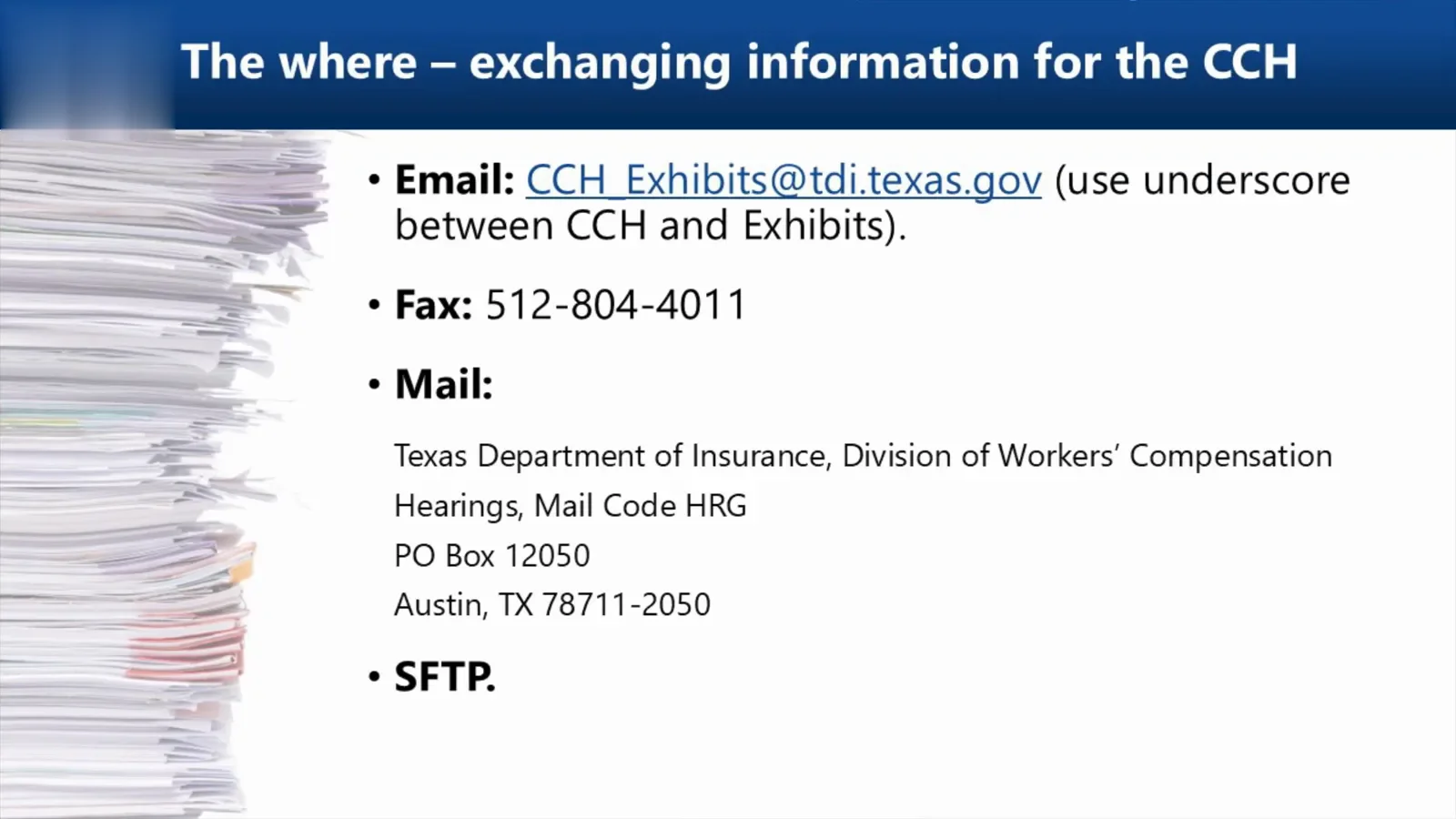
Exhibits go to the division before the hearing — the webinar recommends filing at least three days ahead — and they should be organised and in proper order. The channels are the same family as the BRC exchange: email [email protected] (underscore between CCH and Exhibits), fax 512-804-4011, mail to the hearings address at PO Box 12050, Austin, TX 78711-2050, or secure file transfer. The division schedules the hearing no later than 60 days after the BRC, or 30 days if it is expedited, so the window to file is short. A continuance has its own rules: the motion must be in writing, state the reason, include a certificate of conference, and reach the division no later than five days before the hearing.
The webinar’s own recommendation is three days ahead.Watch at 20:30 - 10
Dispute the first MMI and impairment rating inside 90 days
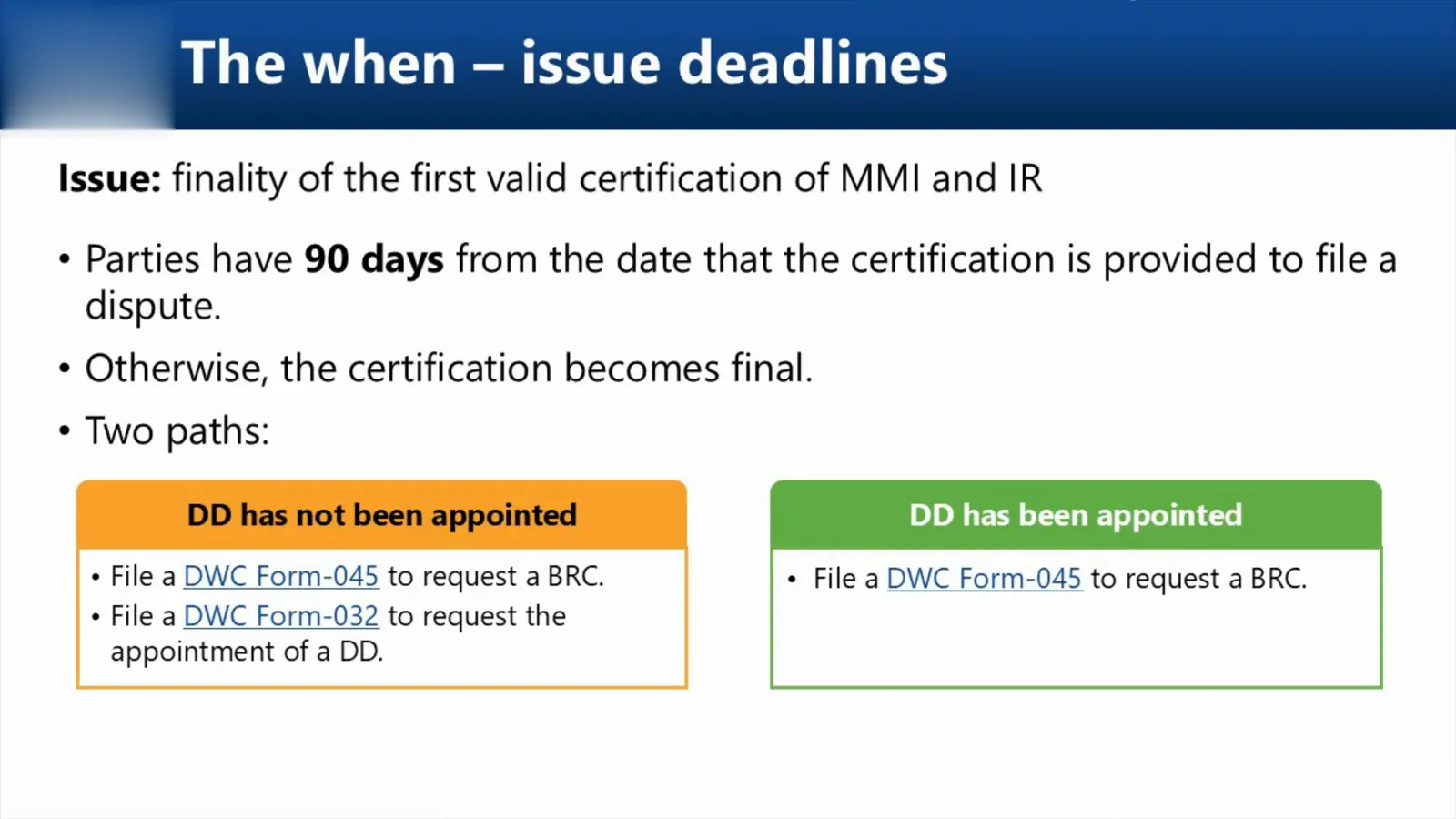
The first valid certification of maximum medical improvement and impairment rating becomes final unless a party disputes it within 90 days of the date the certification was provided by verifiable means. Which form you file depends on whether a designated doctor has been appointed on MMI and impairment rating. If no designated doctor has been appointed, there are two paths: file DWC Form-045 to request a benefit review conference, or file DWC Form-032 to ask for a designated doctor examination. If a designated doctor has already been appointed, the slide gives one path only — file DWC Form-045. Let the 90 days run out and the carrier can keep relying on that rating.
Ninety days from the certification, then it is final.Watch at 26:56 - 11
Work the BRC deadlines, including the two-conference limit
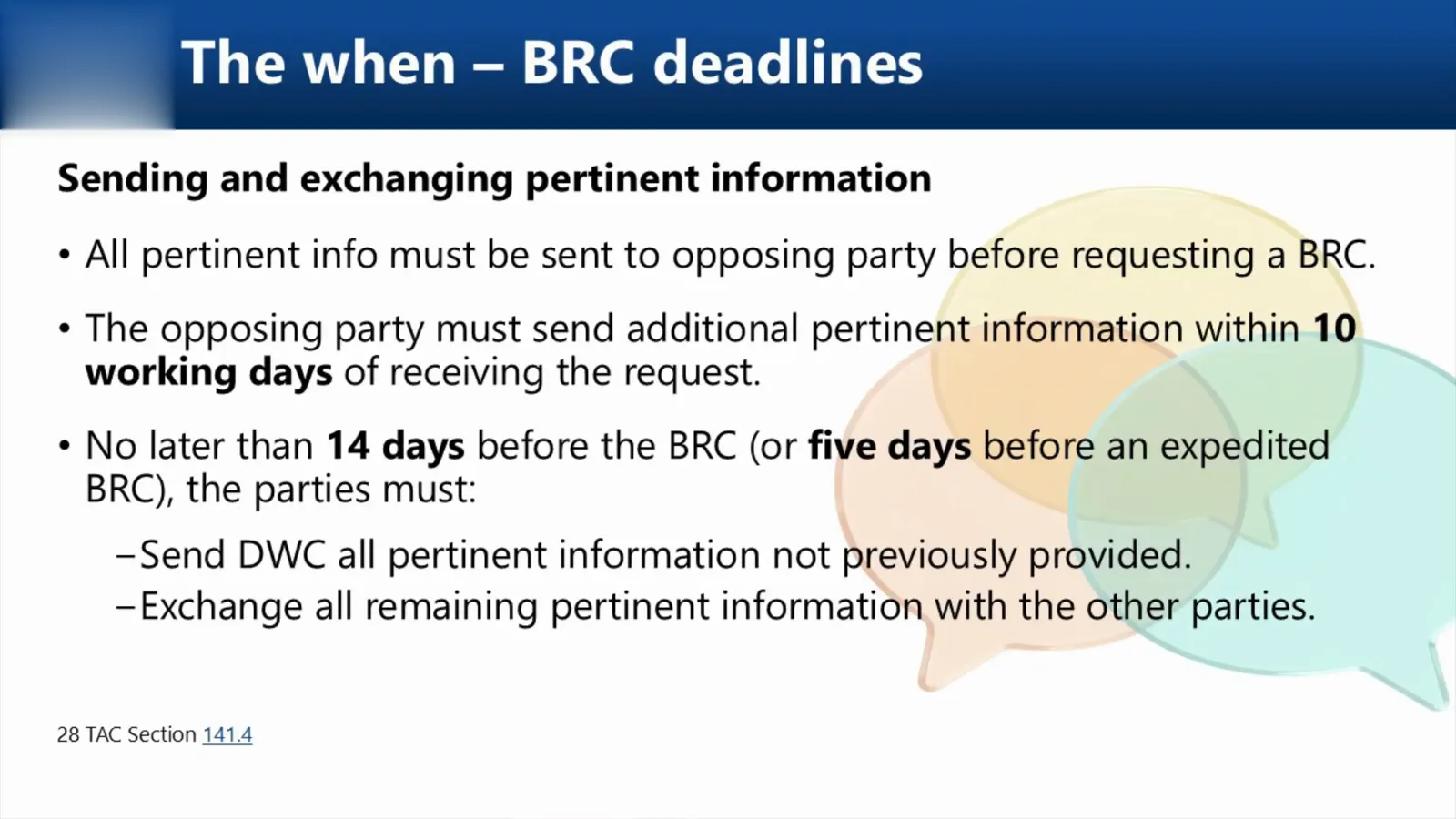
The conference runs on its own calendar. Pertinent information goes to the opposing party before you request the BRC; that party then has 10 working days to add anything; and no later than 14 days before the conference (five days for an expedited BRC) everything remaining goes to DWC and to the other side. A request to cancel or reschedule must be made within 10 days after the notice of setting is received — the first request inside that window needs no showing of good cause, but later requests must show it. A benefit review officer may schedule at most two BRCs on a dispute, so treat the second one as your last real chance to settle before a judge decides.
The conference runs on its own filing calendar.Watch at 32:18 - 12
Exchange the hearing documents within 15 days of the BRC
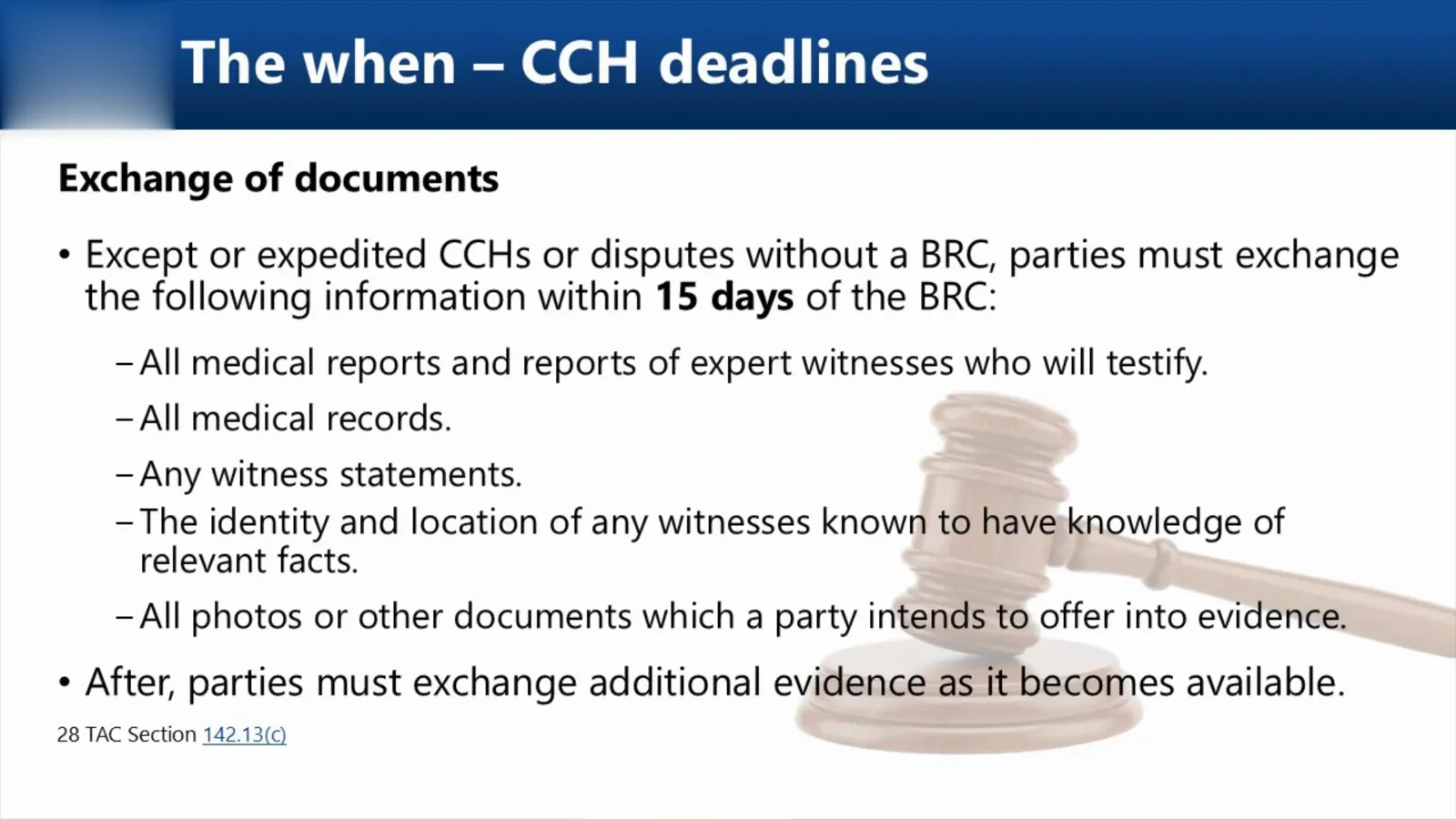
Except for expedited hearings and disputes that never had a BRC, the parties must exchange the hearing evidence within 15 days of the conference: every medical report and every report of an expert witness who will testify, all medical records, any witness statements, the identity and location of witnesses known to have knowledge of relevant facts, and every photograph or document a party intends to offer into evidence. After that, additional documentary evidence is exchanged as it becomes available. Late exchange is the most common objection to admissibility at a contested case hearing, and the judge decides that objection on whether good cause existed for the delay — a document you sat on can be kept out of the record entirely.
Late exchange is how evidence gets excluded.Watch at 36:45 - 13
Appeal the judge’s decision to the Appeals Panel within 15 days
The Appeals Panel does not hold hearings. It reviews the record developed at the contested case hearing together with the written request for appeal and any response, and it can reverse and render a new decision, reverse and remand the case to the judge for more action, or affirm. A party has 15 days to file the appeal, and the start date depends on how the decision was delivered: five days after it was mailed by regular mail, the date it was faxed or sent electronically, or — for insurance carriers only — the first working day after it was placed in the carrier’s Austin representative box. You must serve a copy on the other party, and the response is due within 15 days of that service. Saturdays, Sundays and listed state holidays do not count, and the panel will not consider a late appeal or response.
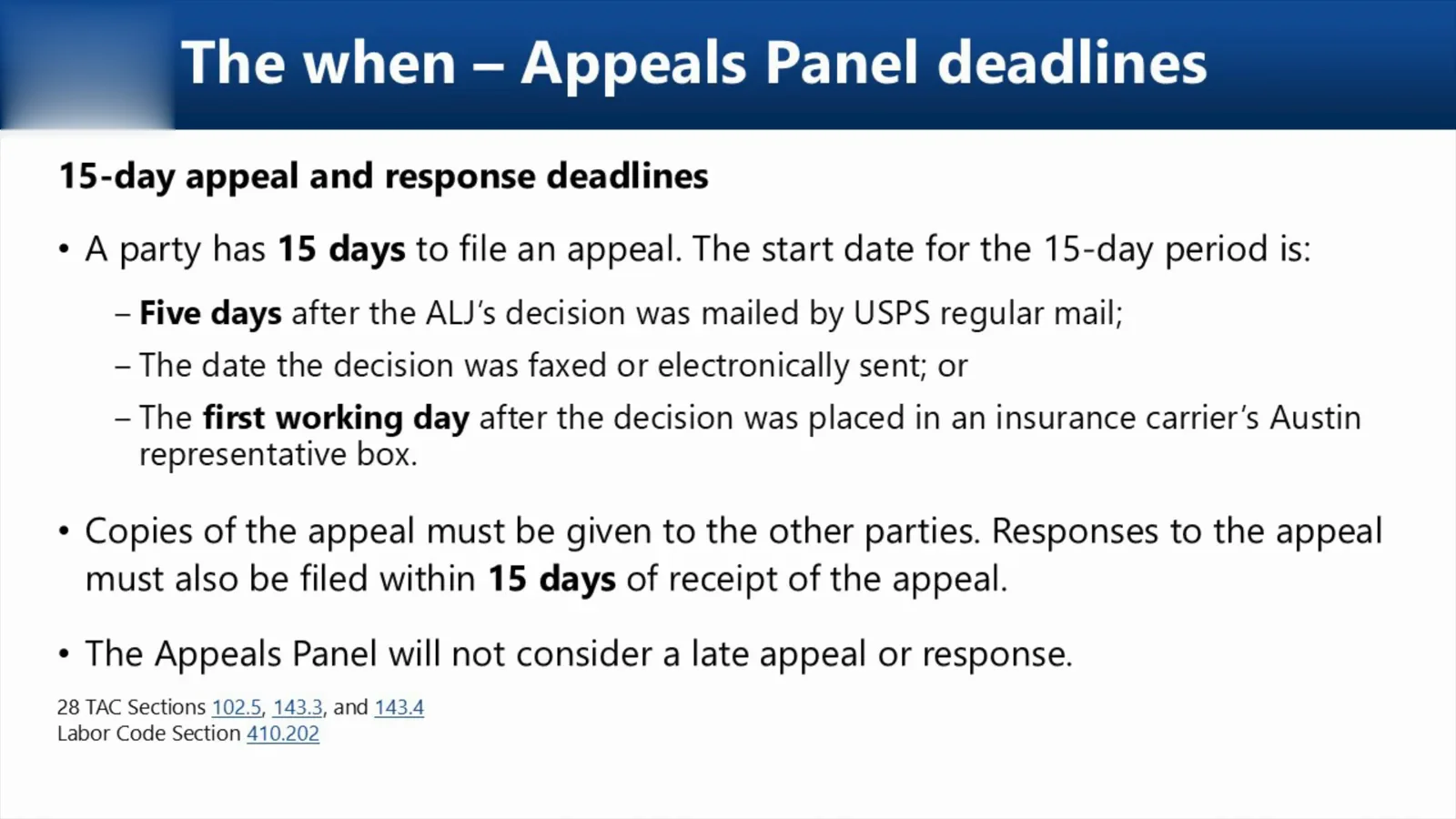
Fifteen days, weekends and holidays excluded.Watch at 41:04 - 14
Take an exhausted case to district court inside 45 days
For most disputes the Appeals Panel is the last administrative step, and judicial review is next. A party must file suit not later than the 45th day after the date the division mailed the Appeals Panel decision or its final determination letter. The petition goes in the county where the employee resided at the time of the injury — or, in a death case, where the employee resided at the time of death. In an occupational disease case it goes in the county where the employee resided when disability began, or any county the parties agree to. When you file, you simultaneously serve the opposing party and give the division a copy of the petition. If the case later produces a proposed judgment or settlement, the division must receive it no later than 30 days before the court enters or approves it; a judgment or settlement that skips that step is void.

Exhaust the administrative remedy first.Watch at 14:58
Frequently asked questions
- Do I need an attorney to appeal a denied Texas workers comp claim?
- No. An injured employee can ask for a benefit review conference with DWC Form-045, attend it and take the case to a contested case hearing without a lawyer. The webinar describes the unrepresented claimant as the party who shows up with an ombudsman from the Office of Injured Employee Counsel instead of an attorney, and the TDI-DWC page on benefit review conferences points to that free help as well as to the DWC customer service line for questions. A lawyer helps most with the appeal to the Appeals Panel, where the written request has to rebut each issue in the judge’s decision.
- What is the difference between a BRC and a contested case hearing?
- A benefit review conference is informal and non-adversarial. You meet a DWC benefit review officer and a representative of the carrier, no record is made, and the officer tries to mediate an agreement onto DWC Form-024. If that fails, the officer issues a BRC report that lists the unresolved issues, and those issues go to a contested case hearing — a formal, adversarial proceeding before an administrative law judge who swears witnesses, takes evidence and argument, and files a written decision within 10 days after the hearing closes.
- How long do I have to appeal an administrative law judge’s decision?
- Fifteen days, and the clock can start in different places. It runs from five days after the decision was mailed by USPS regular mail, from the date it was faxed or sent electronically, or — for insurance carriers only — from the first working day after it was placed in the carrier’s Austin representative box. Saturdays, Sundays and listed state holidays do not count toward the 15 days. You must serve a copy of the appeal on the other party, the response is due within 15 days of that service, and the Appeals Panel will not consider a late appeal or response.
- What happens if I miss the 90-day deadline on my impairment rating?
- The first valid certification of maximum medical improvement and impairment rating becomes final, and the insurance carrier can keep relying on it. Before the 90 days run out you can dispute it, but the form depends on whether a designated doctor has been appointed: with no designated doctor you may file either DWC Form-045 to request a benefit review conference or DWC Form-032 to ask for a designated doctor examination; with a designated doctor already appointed on MMI and impairment rating, the webinar’s slide gives one path only — DWC Form-045.
- Can the insurance carrier appeal too?
- Yes. The Appeals Panel hears appeals from any party, and the carrier’s 15-day window can start from the first working day after the decision reached its Austin representative box. The panel can reverse and render a new decision, reverse and remand the case to the administrative law judge for more action, or affirm. If it does not write a decision, it issues a determination letter and the judge’s decision becomes the final decision of the division — which is when judicial review in district court becomes available, on a 45-day deadline.
Keep reading
Educational information only, not legal advice. The steps come from the TDI-DWC CompCourses webinar “Dispute Resolution: The Who, What, When, Where, Why, and How” and the TDI-DWC benefit review conference page; screenshots are frames from that webinar. Deadlines in Texas workers’ compensation are short and counted in different ways, so confirm your own dates with an attorney, an OIEC ombudsman or the DWC before you rely on them.