DWC-1 filing guide
How to file a workers’ comp claim online in California
California has no statewide portal for a workers’ comp claim, so “online” means downloading the fillable DWC-1 from the DWC, typing into it, and getting the signed form to your employer. Here is every line, in the order the form asks for them.
The short answer
- Filing starts with one form. Your employer must give or mail you a DWC-1 within one working day of learning about the injury; if it does not, download the fillable PDF from the DWC forms page at dir.ca.gov/dwc/forms.html.
- You complete only the employee section, lines 1 to 9: name, today’s date, home address, date of injury, where it happened, what was injured, Social Security number, email-notice choice and your signature.
- The date-of-injury line is where claims go wrong. A specific injury gets the single date it happened; a repetitive-motion injury gets the whole period from your approximate start date through your last physical day of work.
- List every body part and symptom that work made at least partly worse — not just the one that hurts most today. A prior injury that work aggravated counts as a new claim.
- Hand the signed form to your employer in person, or mail it certified with return receipt, then watch the clock: treatment within one day, a status letter generally within 14 days, and a claim not denied within 90 days is presumed work-related.
Source video
HOW TO FILE A WORKERS’ COMPENSATION CLAIM WITHOUT AN ATTORNEY - DWC-1 FORM. BY ATTORNEY MARK LARSON
Mark Larson, Esq. — Larson, Larson & Dauer, ALC (YouTube channel: Mark L)
Screenshots are frames from the video above, taken only from its full-screen recordings of the DWC-1 form; none of the video’s talking-head or caption-slide frames are used here. The written steps are our own, and the deadlines, the 14-day status letter and the 90-day presumption were cross-checked against the California DWC “How to file a claim” page: www.dir.ca.gov/dwc/FileAClaim.htm
How to file a workers’ comp claim online, step by step
Sixteen steps, from getting the form to the first 90 days of your claim. Every screenshot is a still from the source video and links to the exact second it was taken.
- 1
Know what filing a claim actually does
Filing a California workers’ compensation claim is one act: telling your employer, in writing, that you were injured at work and that you want the benefits the workers’ comp system pays for. The written form is the DWC-1. It is an insurance claim against your employer’s workers’ compensation carrier — the attorney in the source video is careful about this — and it is not a lawsuit against your employer or the insurance company. The carrier will contact your employer to confirm you worked there and to check what you had already reported, so the story on the form and the story you told your supervisor should match.
- 2
Get the DWC-1 form within one working day — or download it yourself
Tell your supervisor as soon as you can. California rules require your employer to give or mail you a DWC-1 claim form within one working day of learning about the injury, and the DWC says to report the injury within 30 days, warning that a late report can cost you benefits. If no form appears, download it from the DWC forms page at dir.ca.gov/dwc/forms.html, which also publishes the form in Chinese, Korean, Tagalog and Vietnamese; the standard DWC-1 itself carries the English and Spanish text on the same sheet. Download the fillable PDF to your desktop rather than typing in a browser preview, and use the PRINT and CLEAR buttons in the form header when you are finished.
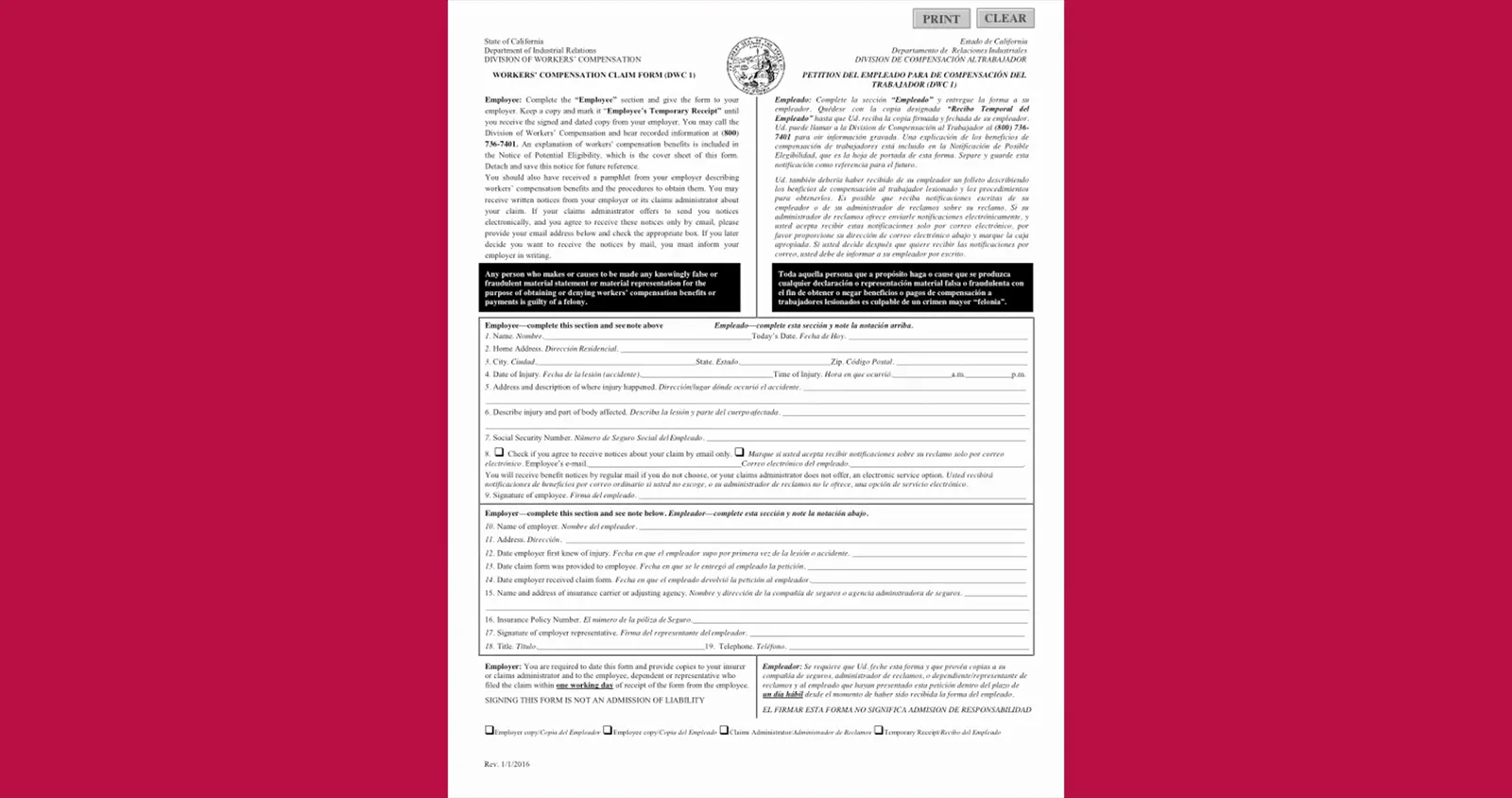
One page, two languages: the DWC-1 is printed in English and Spanish side by side.Watch at 3:06 - 3
Line 1: write your full legal name
Line 1 wants your full legal name — the name you use at work and the one that shows on your paycheck. Everything that follows on the claim, from the adjuster’s letters to the case number, is indexed under this name, so a nickname or an abbreviated first name is worth avoiding here.
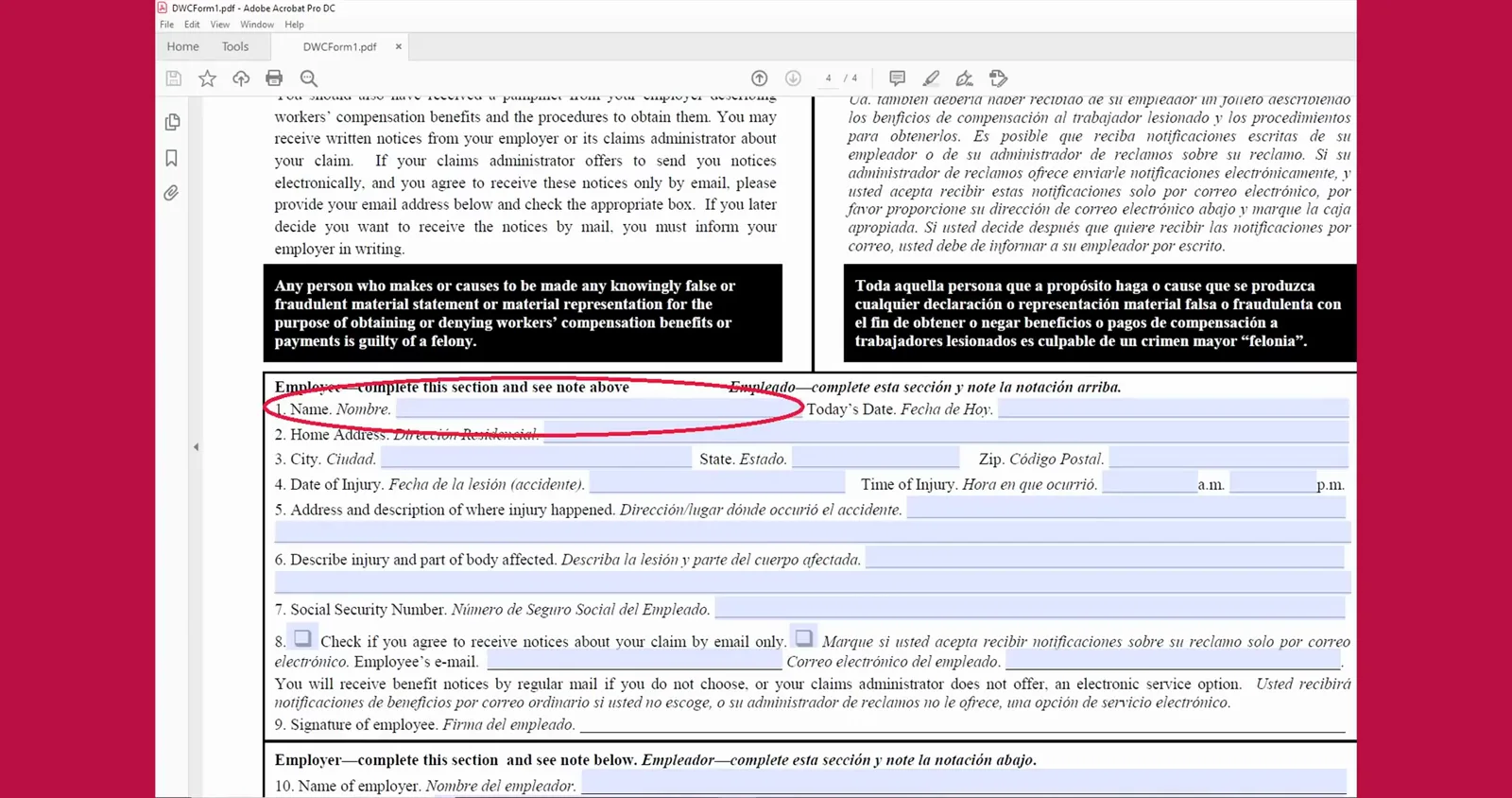
Use the name payroll knows you by.Watch at 3:46 - 4
Line 1: put today’s date, not the injury date
The date sitting to the right of your name is the date you are filling out the form. It does not have to be the day you were injured — the injury has its own line, number 4, further down the page. Read the calendar before you sign so the two dates are not confused.
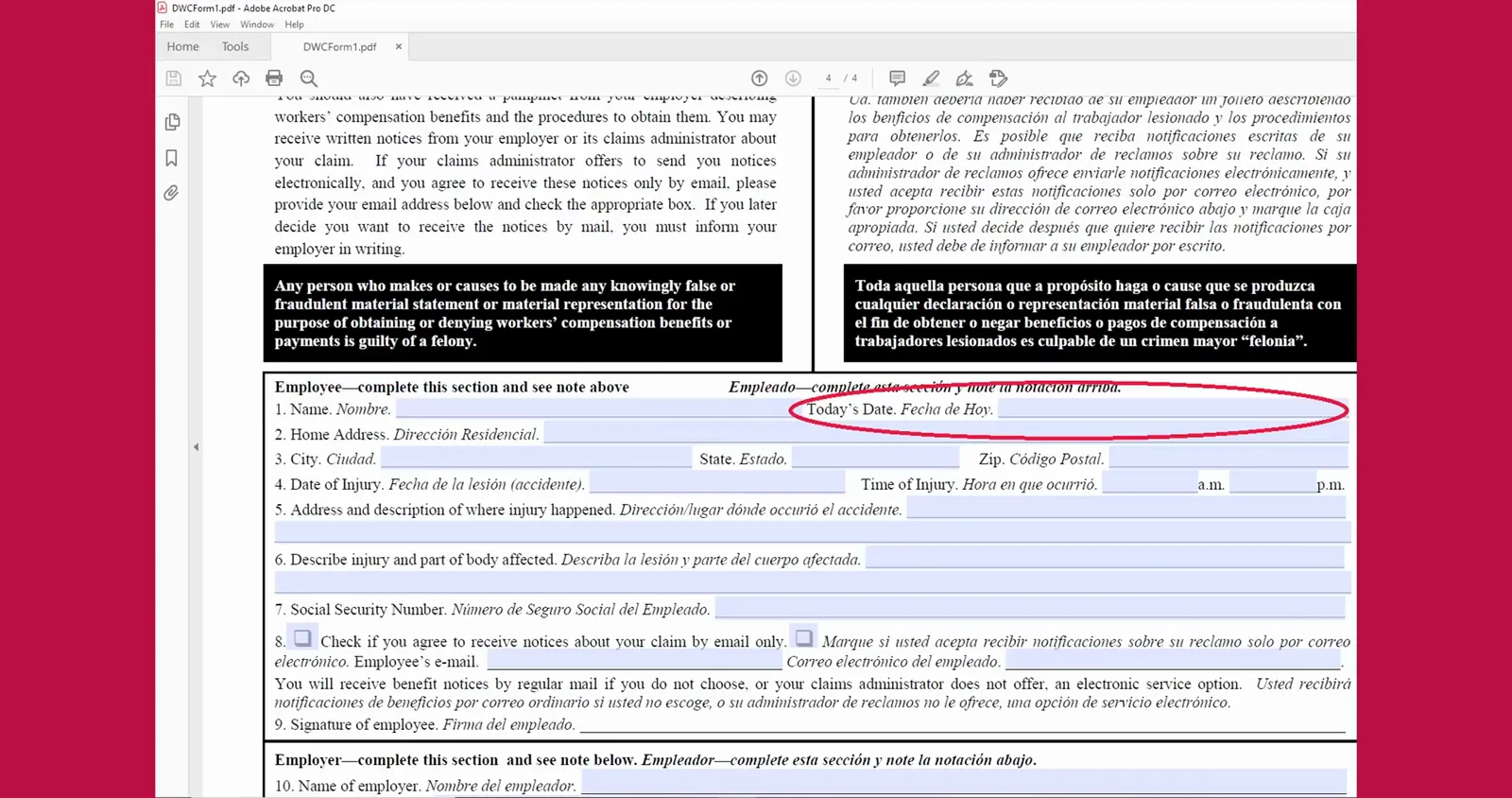
This date is today, not the day you got hurt.Watch at 3:52 - 5
Lines 2 and 3: the home address where notices should arrive
Line 2 takes your home address and line 3 splits the city, state and ZIP code onto one row. This is the address the claims administrator and the DWC use for further information and correspondence about the claim, so give the address where mail will actually reach you.
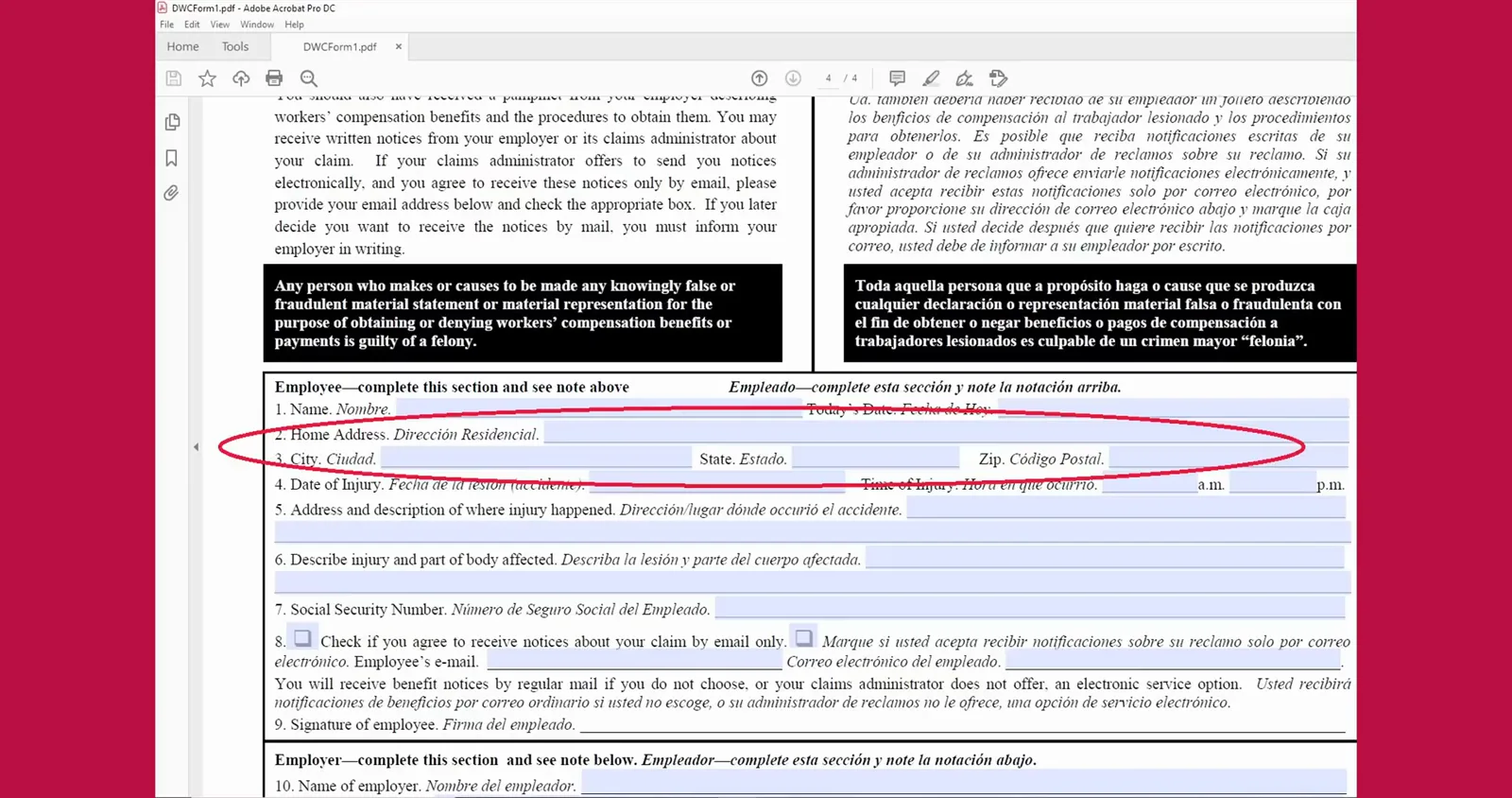
Notices about your claim will be mailed here.Watch at 4:06 - 6
Line 4: the date of injury, the line most claims get wrong
Two kinds of injury date exist and they are written differently. A specific trauma — a fall from a ladder or roof, a car accident, a burn, a pop in your back from heavy lifting — gets the single calendar date it happened. A cumulative trauma, meaning a repetitive-motion injury such as carpal tunnel from years of typing, gets the whole period you worked for that employer: the approximate start date through the last date you physically worked before filling out the form. The source video writes 8/1/2015 – 8/5/2020 for the first type of entry and 8/2015 – 8/5/2020 for a worker who does not remember the exact start day; month and year are fine, and the end date is normally your last physical day of work for that employer.
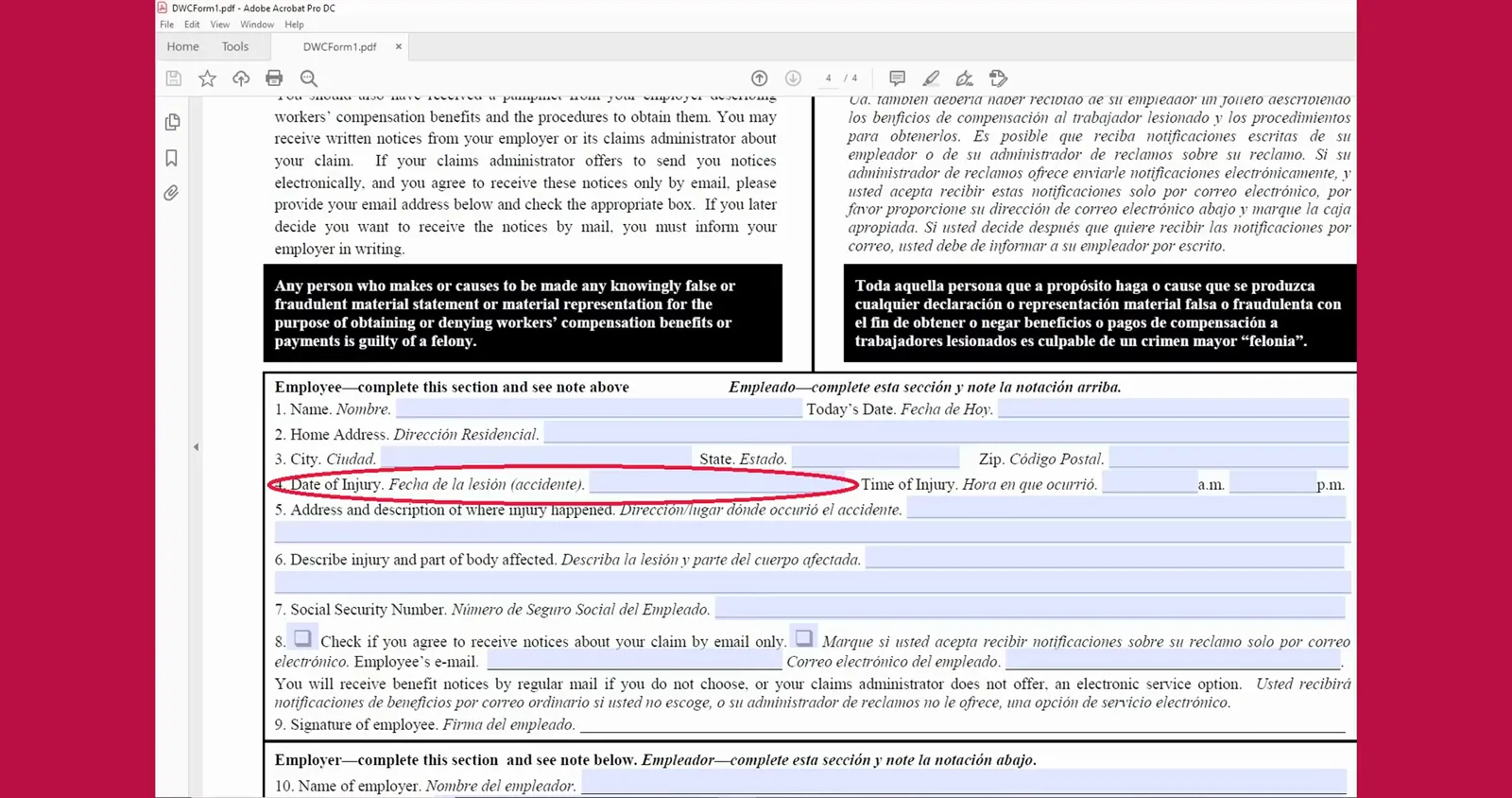
One date, or a whole period — it depends on the kind of injury.Watch at 4:26 - 7
Line 4: the time of injury only belongs to a specific trauma
The small a.m. and p.m. boxes beside the date belong to a specific-trauma claim. If the injury happened at a particular moment, write the time you know. If it developed over months or years, leave the time blank: there is no single hour for a repetitive-motion injury, and an invented time is worse than an empty box.
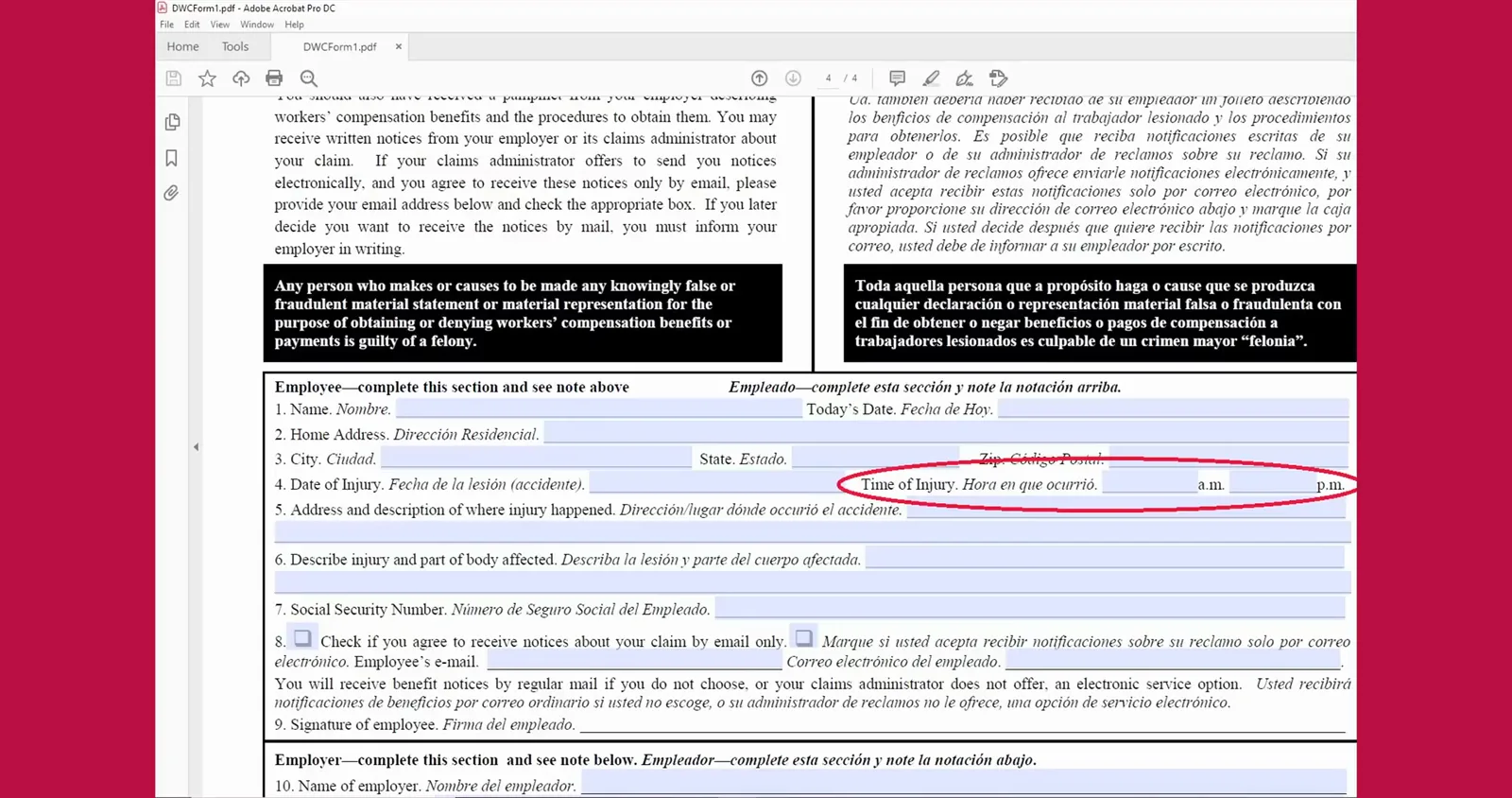
Specific event, specific time — otherwise leave it empty.Watch at 7:16 - 8
Line 5: the address and description of where the injury happened
Normally this is your employer’s address, the place you go every day. If you were working somewhere else — the video’s example is being rear-ended while driving to a client’s house — put as much detail as you can. If you genuinely do not know, leave it blank: the source attorney’s advice is that a blank beats a wrong address, because the insurer’s first investigation runs on this line.
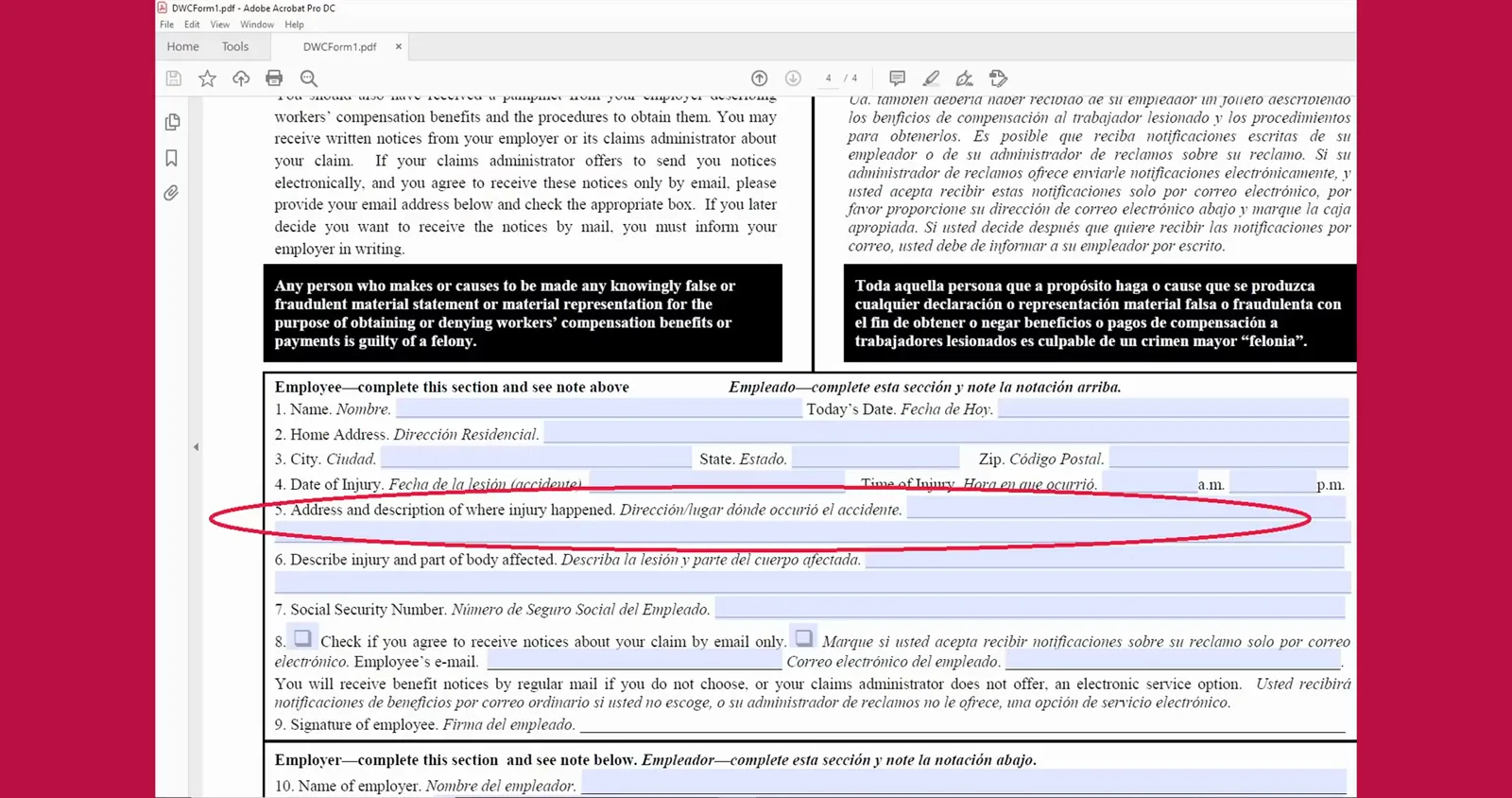
Usually the workplace — but say so if you were somewhere else.Watch at 7:24 - 9
Line 6: describe the injury and every body part affected
The attorney calls this the most important section on the form. Write a full list of your injuries rather than only the one that hurts worst today, and include anything that bothers you and that you believe work caused at least in part. “At least in part” covers an older injury that employment aggravated or made permanently worse — that is a new claim for it. Use plain words: left wrist with numbness in two fingers, low back with pain down the leg, hearing loss, skin rash, anxiety and trouble sleeping. An injury you never wrote down is an injury you have to argue about later.
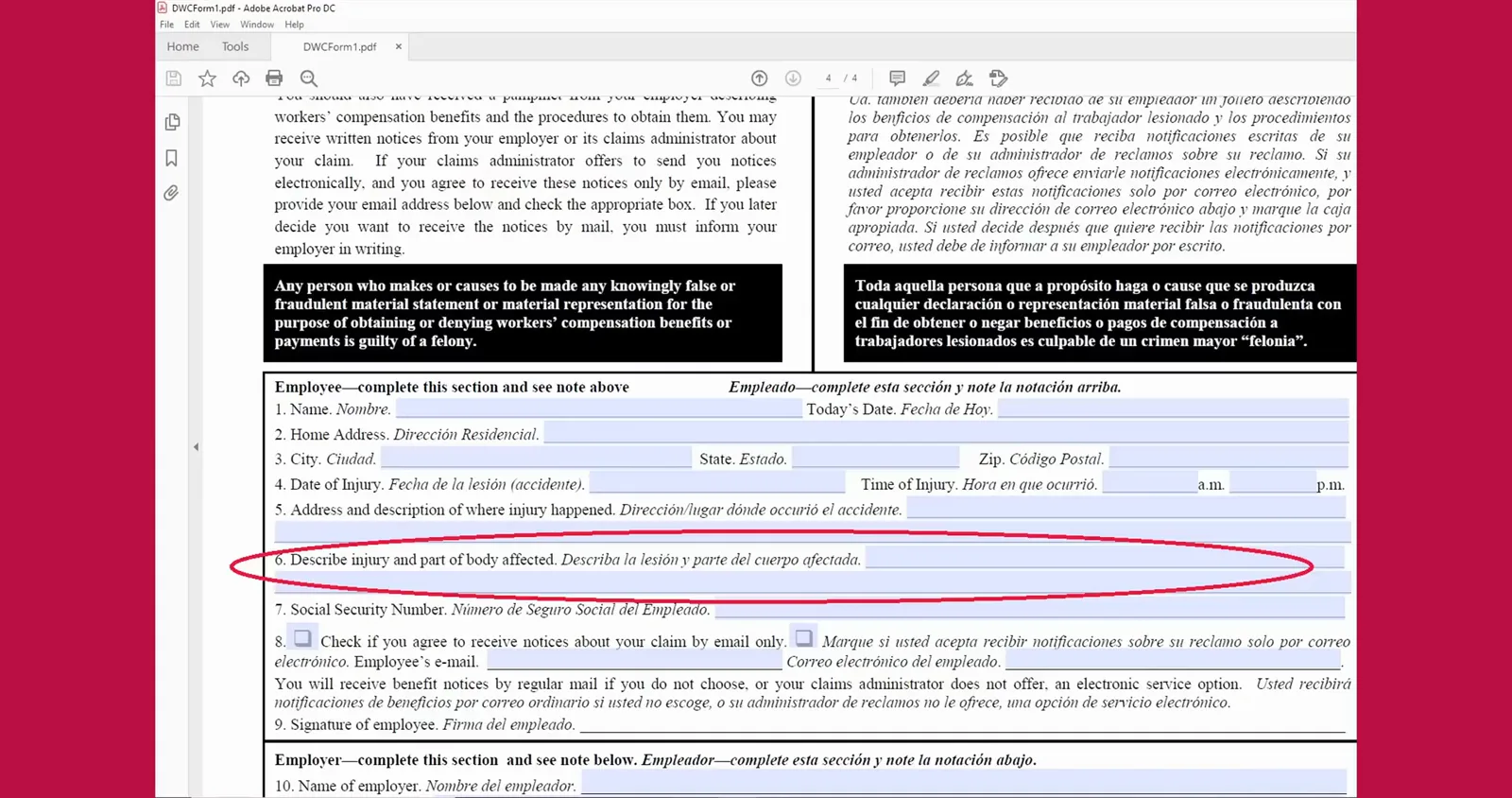
Everything that hurts, not just today’s worst spot.Watch at 8:00 - 10
Making a claim is not the same as being taken off work
These two things get confused, so the source video stops on it. Filing the DWC-1 and listing body parts is a claim for benefits; work restrictions are a medical decision. The claim itself does not take you off work — what takes you off work, or changes what you do, is a restriction a doctor writes. That is why the video tells workers to talk with their treating doctor about what they can still do, and to keep any restriction within what the job actually requires.
- 11
Line 7: the Social Security number is your call
Your employer already holds your Social Security number in its payroll records, and line 7 asks you to repeat it. The attorney in the source video tells unrepresented workers to leave this line blank if they are uncomfortable filling it in, and describes disclosure at this stage as voluntary. Whatever you decide, keep the rest of the form honest: the form itself carries a warning that a knowingly false or fraudulent statement made to obtain or deny benefits is a felony.
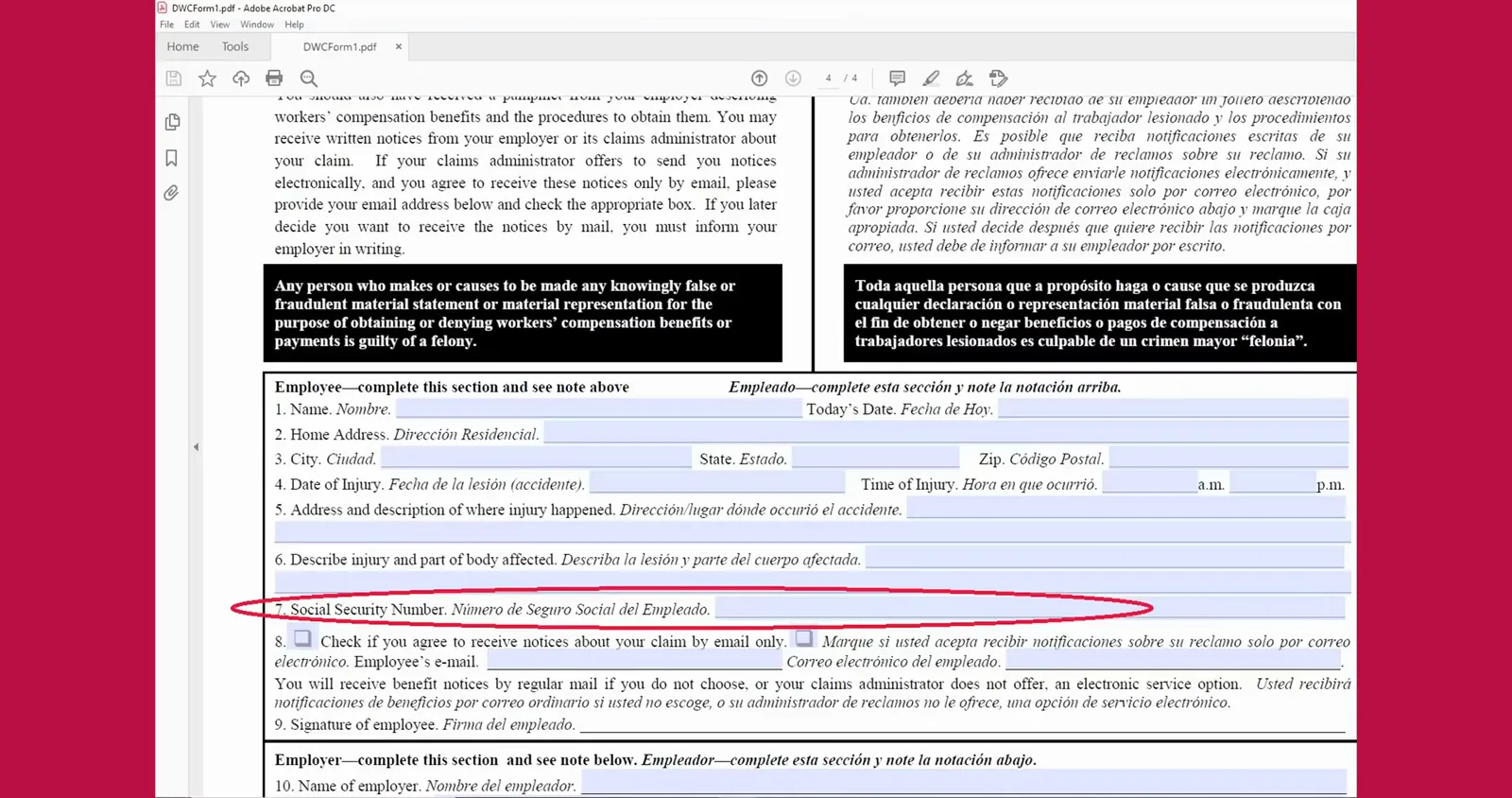
Your employer already has the number from payroll.Watch at 9:20 - 12
Line 8: the email-notice checkbox
Line 8 asks whether you agree to receive notices about your claim by email only. The video’s recommendation is to leave the box unchecked and not to supply an email address, so the claims administrator has to mail paper notices to the home address you entered on line 2. The form itself spells out both sides: you receive benefit notices by regular mail if you do not choose an electronic option, and if you later change your mind you have to tell your employer in writing.
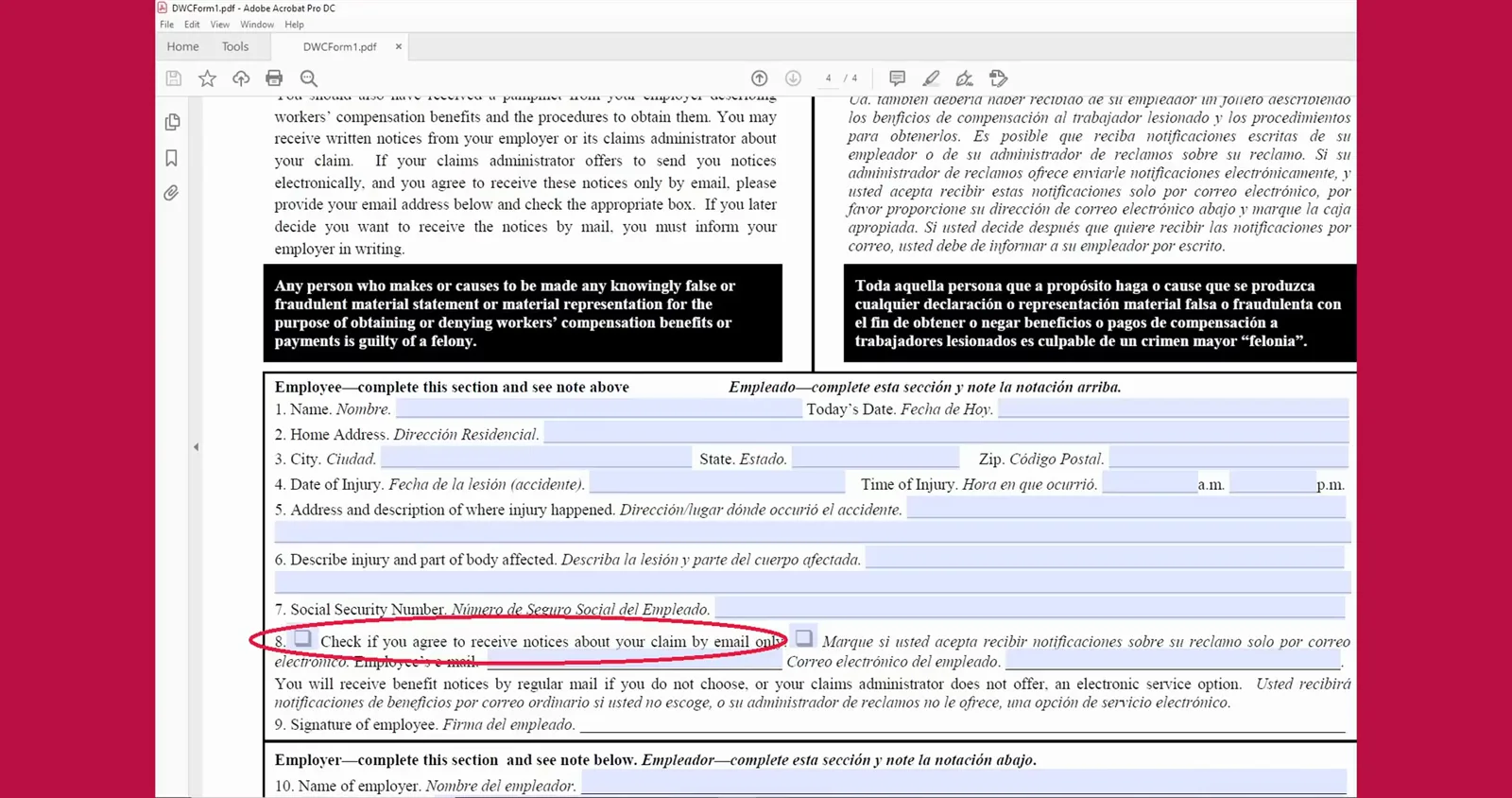
Leave the box empty and the paper notices keep coming.Watch at 9:40 - 13
Line 9: sign it and keep a copy
Line 9 is the employee signature. Sign and date the form yourself before it leaves your hands — the DWC asks for a signed, dated claim form, and an unsigned one will not open your case. The video’s instruction is to make a copy first; the DWC adds that you can mark your copy as the employee’s temporary receipt until the signed and dated copy comes back from your employer.
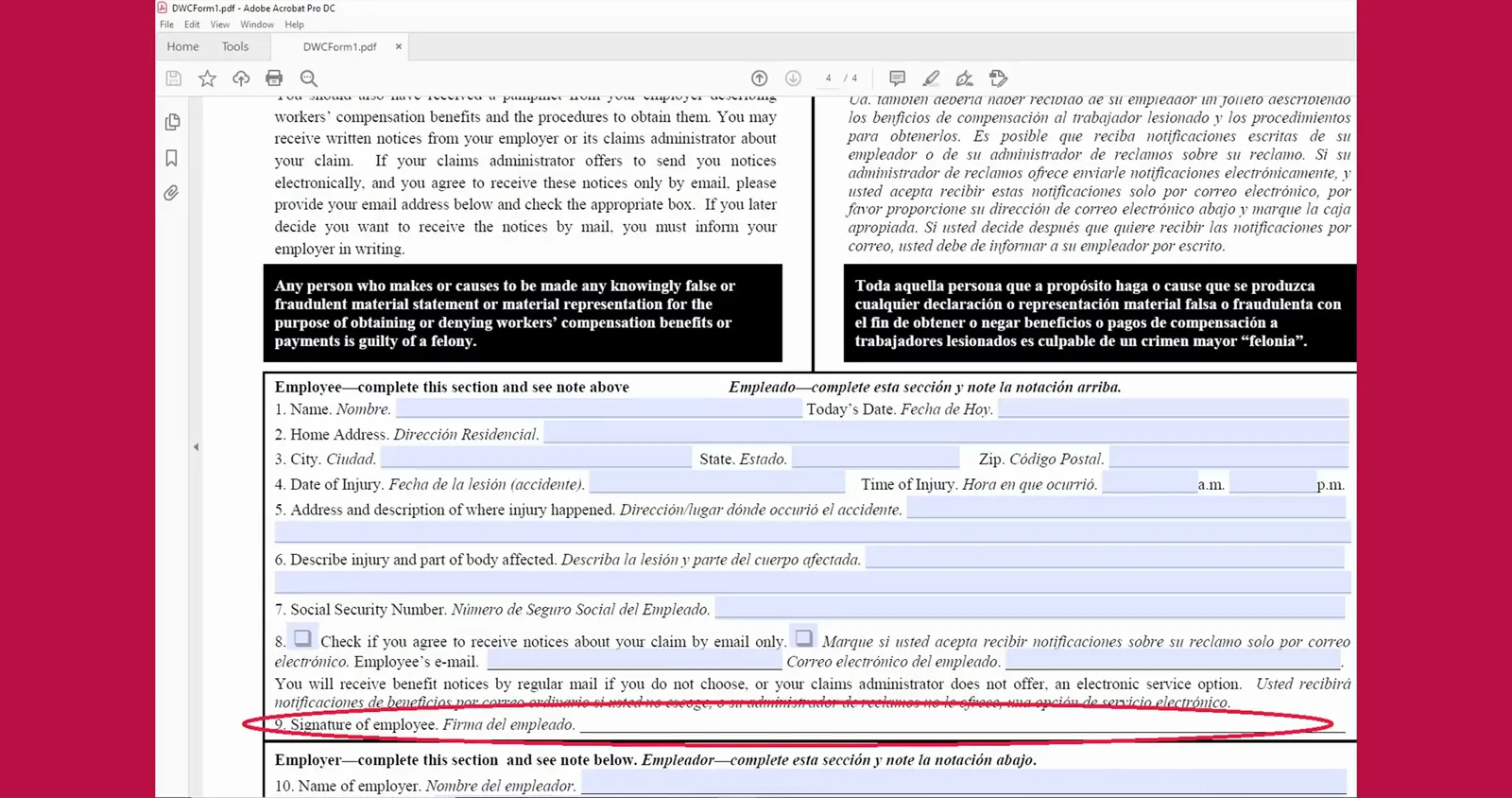
An unsigned form is not a filed claim.Watch at 9:46 - 14
Lines 10 to 18: stop, this part is the employer’s
Everything from line 10 down is the employer’s section: employer name and address, the date the employer first knew about the injury, the dates the form was provided and received, the name and address of the insurer or adjusting agency, the policy number, and the employer representative’s signature. Do not fill in any of it. Your employer completes those lines and forwards the form to the workers’ compensation insurance company, and you should receive a copy of the completed form back — ask for it if it never arrives, and keep it with the rest of your claim paperwork.
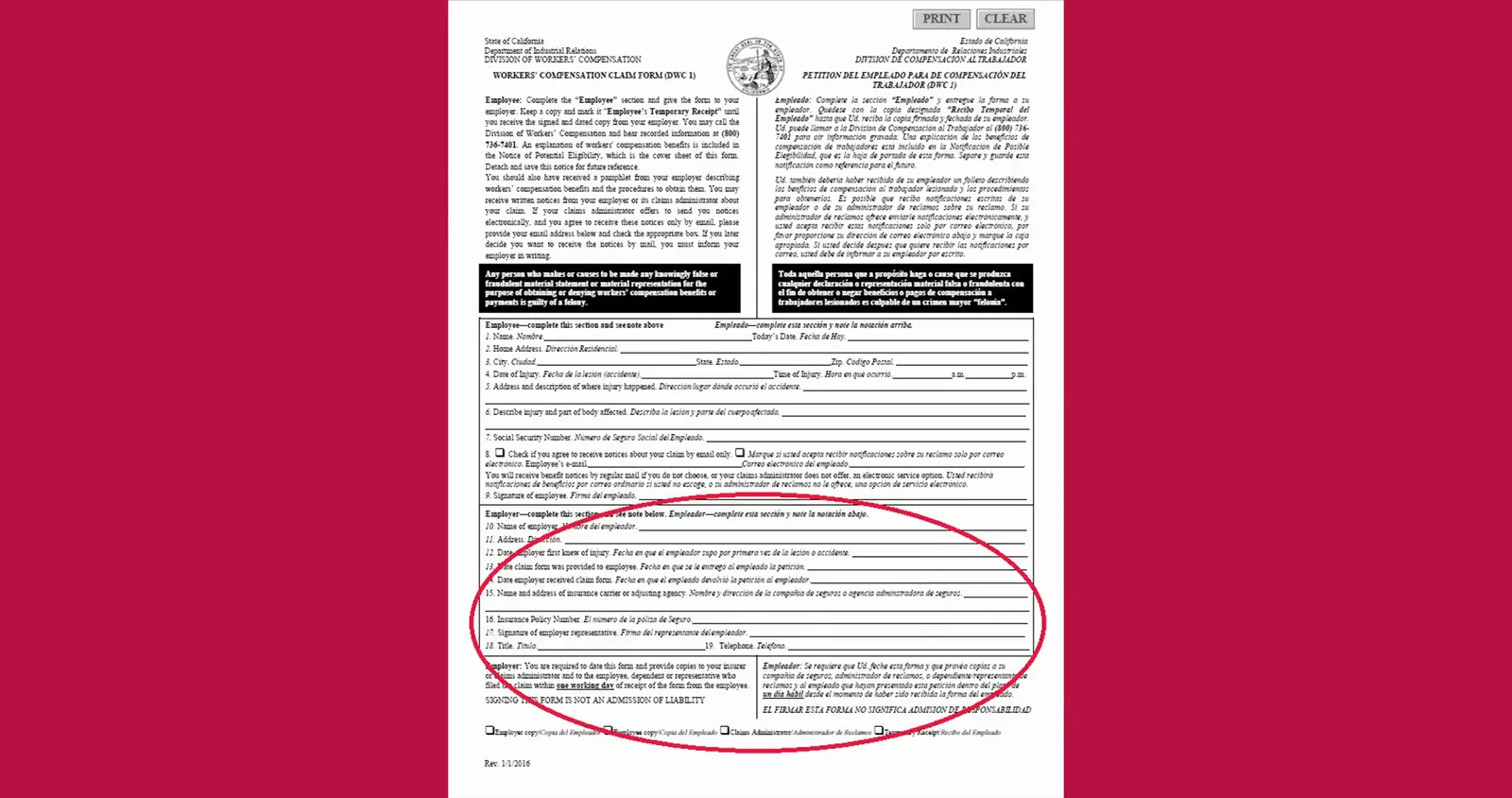
Stop at line 9 — lines 10 to 18 belong to your employer.Watch at 10:00 - 15
Deliver the form and keep proof of the date
Give the completed form to your employer right away. The DWC’s instruction is to return it in person or by mail, and if you mail it, to use certified mail with return receipt requested so you have a record of the day it went out and the day it arrived. If handing it over in person is awkward — a small employer, or a supervisor you are already in conflict with — the source attorney says emailing or faxing the form is a reasonable alternative as long as you confirm the employer actually received it. What you should not do is sit on it: the DWC warns that failing to return the completed form can put your right to benefits at risk.
- 16
What should happen next — and when to pick up the phone
Once the employer has your form, medical treatment must be authorized within one day, and the DWC puts a number on it: while the claim is being accepted or rejected you may receive up to $10,000 in treatment. The insurance company generally has 14 days to mail you a letter telling you the status of your claim, and a claim your employer does not deny within 90 days of receiving the completed form is presumed to be work-related. If no letter arrives and no treatment is authorized, call the claims administrator named on your paperwork, or the DWC Information Services Center at 1-800-736-7401 — the number printed on the form itself.
Frequently asked questions
- Can I file a California workers’ comp claim completely online?
- There is no statewide portal where you file a DWC-1 with the State of California. The online part is real but limited: you download the fillable form from the DWC forms page and type into it on your computer instead of writing it by hand. The filing itself happens between you and your employer — complete the employee section, sign it, keep a copy and deliver it in person or by mail. If your employer or its claims administrator runs its own portal or accepts email or fax, that covers delivery; the attorney in the source video suggests email or fax for workers who would rather not hand it over in person, as long as you confirm receipt.
- Do I have to tell my employer that I am filing a claim?
- Yes. Your supervisor needs to know as soon as possible, and the DWC warns that if the employer does not learn about the injury within 30 days, or cannot fully investigate because the report came late, you could lose your right to benefits. Expect the insurance company to contact your employer: it verifies that you worked there and checks what you had already reported. That is exactly why the story on the form and the story you told at work should match.
- What date do I write for a repetitive-motion injury?
- The whole period, not one day. A cumulative trauma claim asks for the approximate start date through the last date you physically worked for that employer before filling out the form — the source video writes 8/2015 – 8/5/2020 when the exact start day is forgotten. Use a single calendar date only when something specific happened: a fall, a lift that hurt, a car accident, a burn.
- Should I put my Social Security number on line 7?
- It is your decision. Your employer already has the number from payroll, and the attorney in the source video advises unrepresented workers to leave line 7 blank if they are uncomfortable, describing disclosure at this stage as voluntary. Whatever you choose, keep the rest of the form accurate: the form itself warns that a knowingly false or fraudulent statement made to obtain or deny workers’ compensation benefits is a felony.
- What should I double-check before I sign?
- Four lines carry most of the weight: the name on line 1 matching your paycheck, the line 4 date of injury written the right way for your kind of injury, line 6 listing every body part and symptom work made worse, and the line 2 address where notices will actually reach you. Confirm that lines 10 to 18 are still empty, because that is the employer’s section. Then sign at line 9, copy the whole form, and give the original to your employer.
- What happens after my employer gets the DWC-1?
- Your employer completes the employer section and forwards the form to its workers’ compensation insurer, and you should receive a copy of the completed form back. Treatment must be authorized within one day, and up to $10,000 of treatment is available while the claim is being accepted or rejected. The insurer generally has 14 days to mail you a status letter, and a claim your employer does not deny within 90 days of receiving the completed form is presumed to be work-related. Keep every letter: you will need the claim number when you look the case up online.
Keep reading
Educational information only, not legal advice. Steps come from the source video and the California DWC “How to file a claim” page; the advice on the Social Security number and the email checkbox is the source attorney’s opinion, not a rule. Confirm deadlines and entitlements with your attorney or claims administrator.