Federal injury claim guide
How to file a CA-1 for a federal work injury
A federal workplace injury runs on one form: the CA-1. Here is the order to do things in — report it, get the CA-16, file within 30 days, complete items 1 to 15 in ECOMP and prove causation in the medical report.
The short answer
- Form CA-1 is the Department of Labor notice of traumatic injury — one event in one work shift. It must reach your agency within 30 days of the injury to keep continuation of pay, and the claim itself can be filed up to three years later.
- Continuation of pay is up to 45 calendar days of your regular salary, paid by the agency, and it is not charged against your sick or annual leave.
- Report the injury to your supervisor and ask for Form CA-16 the same day; the CA-16 authorizes 60 days of treatment from the date of the injury unless OWCP ends it sooner.
- In ECOMP you complete items 1 to 15, enter your supervisor’s correct email, then sign and submit — and box 13 is where you describe exactly what happened and why.
- Medical evidence supporting the disability, plus a statement of when you can return, is due to the employer within 10 calendar days of filing for COP, and the report must include a causation opinion.
Source video
CA-1 Workers’ Comp Form Explained: How to Get Paid After a Federal Job Injury (Full Walkthrough)
OWCP.DOCTOR
The stills on this page are illustrative diagrams based on the source video above, with its corner watermark cropped out — they are not screenshots of the live ECOMP portal or of the printed federal form, and the step text never asks you to read a field off them. The written steps are our own and are cross-checked against 20 CFR Part 10 (emergency care and Form CA-16 at §§ 10.300–10.302, continuation of pay at §§ 10.200–10.210, medical evidence at §§ 10.115 and 10.330, the three-year notice deadline at § 10.100(b)) and the Department of Labor’s Form CA-1 filing guidance; the item numbering was checked against the printed Form CA-1 (Rev. January 2013): www.ecfr.gov/current/title-20/part-10
How to file a CA-1, step by step
Fifteen steps, from deciding that CA-1 is the right form through reporting the injury, filing in ECOMP, proving causation and protecting continuation of pay. Each illustration links to the exact second in the source video.
- 1
Start with the CA-1, not with the phone calls
A traumatic injury under FECA is one event inside one work shift — a fall, a lift that goes wrong, a hand caught by a tool. Notice of that injury goes to your agency in writing on Form CA-1, and the CA-1 is what opens both your medical coverage and your continuation of pay. While the claim is pending, your agency cannot make you spend sick or annual leave first.

One form, filed fast, is what separates a paid claim from a paperwork fight.Watch at 0:25 - 2
Form CA-1 is your official notice of a traumatic injury
Form CA-1 is the Department of Labor notice of traumatic injury and claim for continuation of pay. It covers an injury that happened in a single work shift, and 20 CFR 10.100 requires you to give that notice in writing and forward it to your employer. The employee completes the front of the form — items 1 through 15 — unless they are incapacitated, in which case an agency official may complete it for them.
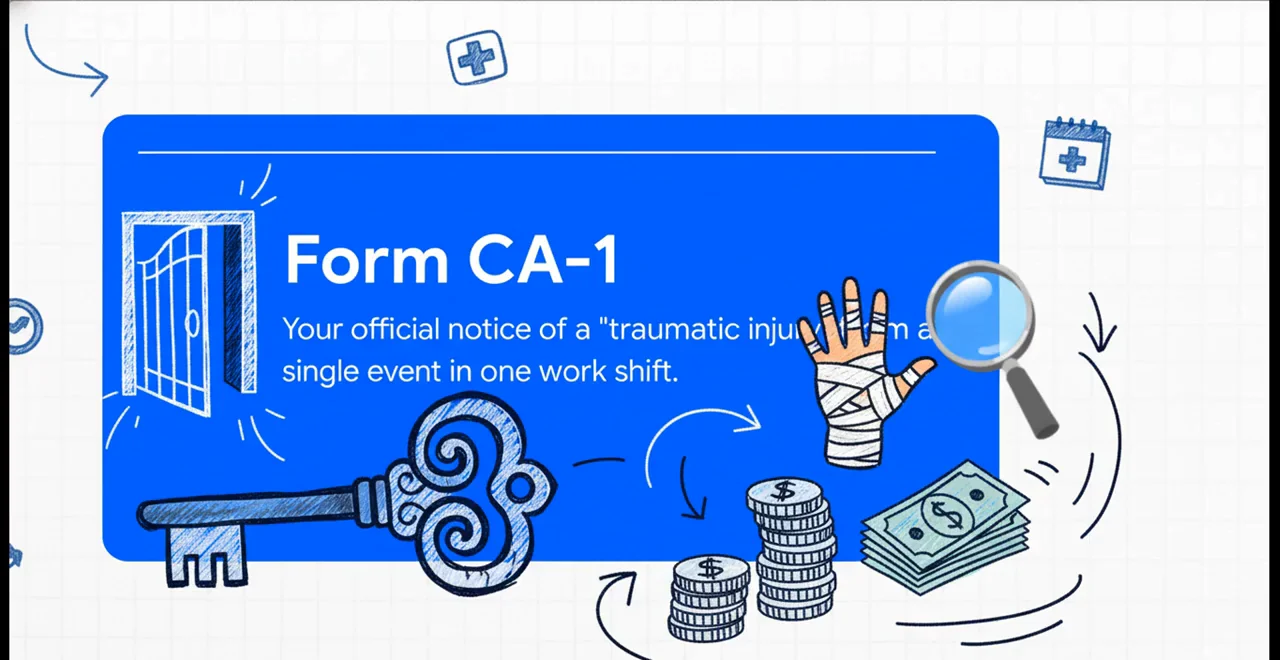
The form does one job: put your agency on written notice.Watch at 0:55 - 3
CA-1 for a single event, CA-2 for a condition that built up
The dividing line is how the condition started. A slip, a fall, a back that gave out while lifting a box — one event, one shift: Form CA-1. Carpal tunnel, hearing loss, a shoulder worn down by repeated motion — a condition that developed over months: Form CA-2, occupational disease. Filing the wrong one is a common reason a claim stalls.
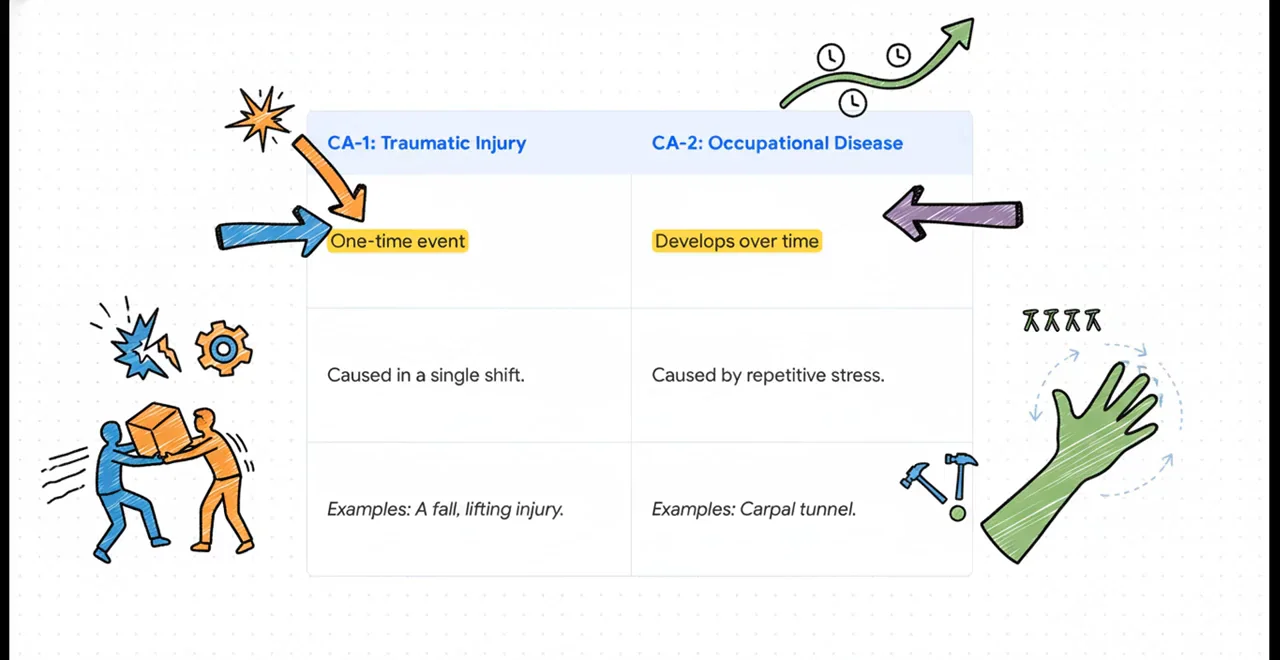
One event, or months of wear: the form follows the mechanism.Watch at 1:25 - 4
Do these two things the same day
Report the injury to your supervisor — that is what starts the clock — and then get medical care. When you report it, say out loud that you need medical care and that you want Form CA-1 and Form CA-16. Under 20 CFR 10.300 the agency is supposed to issue the CA-16 within four hours of the claimed injury, or within 48 hours if it gave verbal authorization first, and it is not required to issue one more than a week later — so the ask has to happen early.
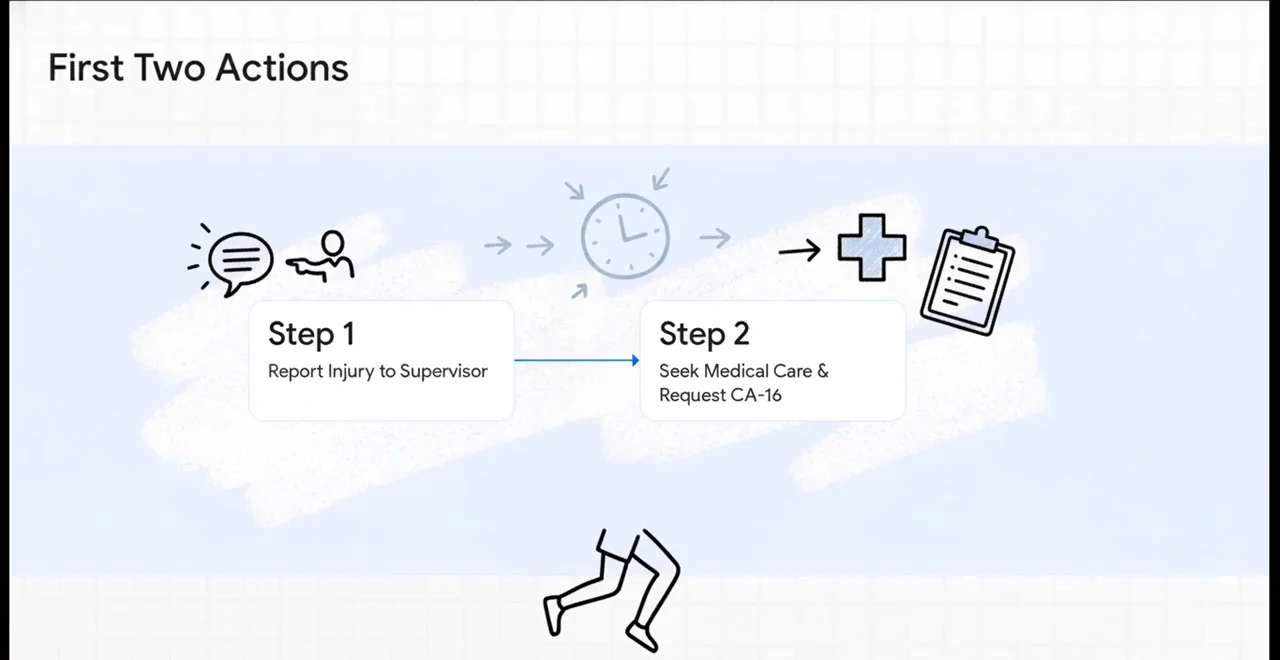
Report first, treat second — both on the day of the injury.Watch at 3:32 - 5
Report it specifically, not vaguely
Give the exact time and place, what you were doing and how the injury happened, and name anyone who saw it. Vagueness is the fastest way to get a claim questioned: the injury report is the first thing OWCP reads and the one document your employer has to act on. If you can, write down what you told your supervisor and when you told them.
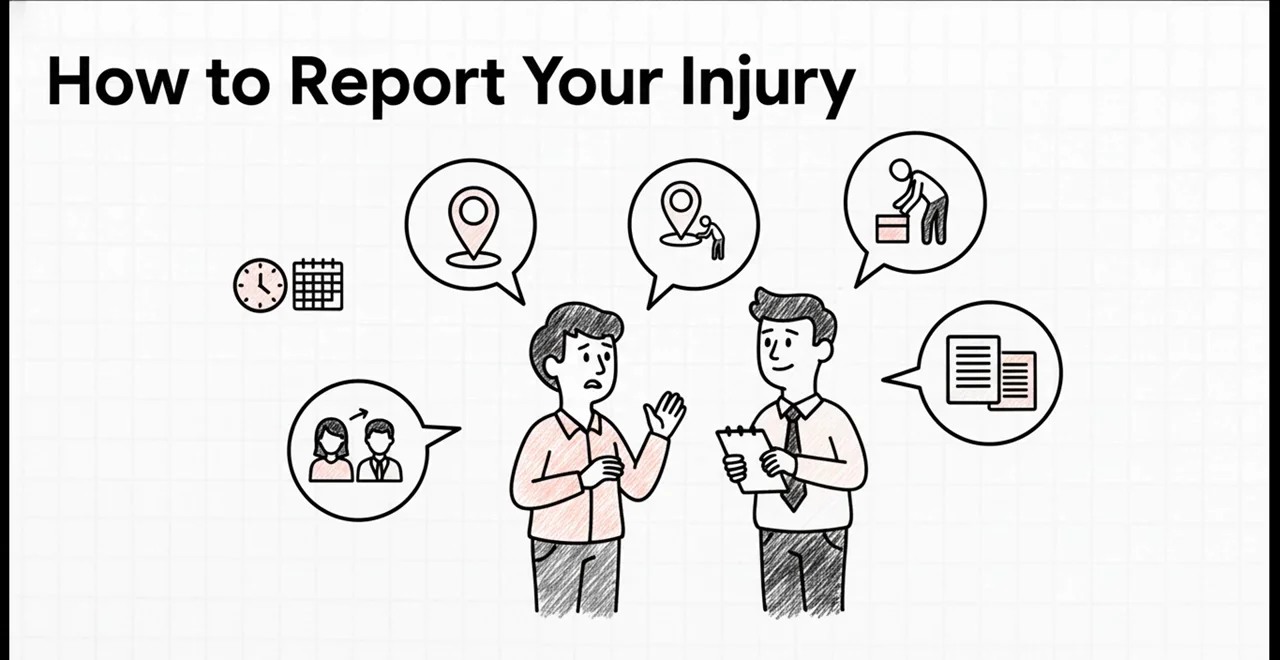
Time, place, witnesses, mechanism — write them down while they are fresh.Watch at 3:45 - 6
Pick up Form CA-16 before you see the doctor
Form CA-16 is the agency authorization for examination and treatment. The regulation states that it authorizes treatment for 60 days from the date of injury unless OWCP terminates the authorization sooner, and it must name the physician or facility that is authorized. Hand it to the treating provider so the bill goes to the agency instead of to your own health plan.
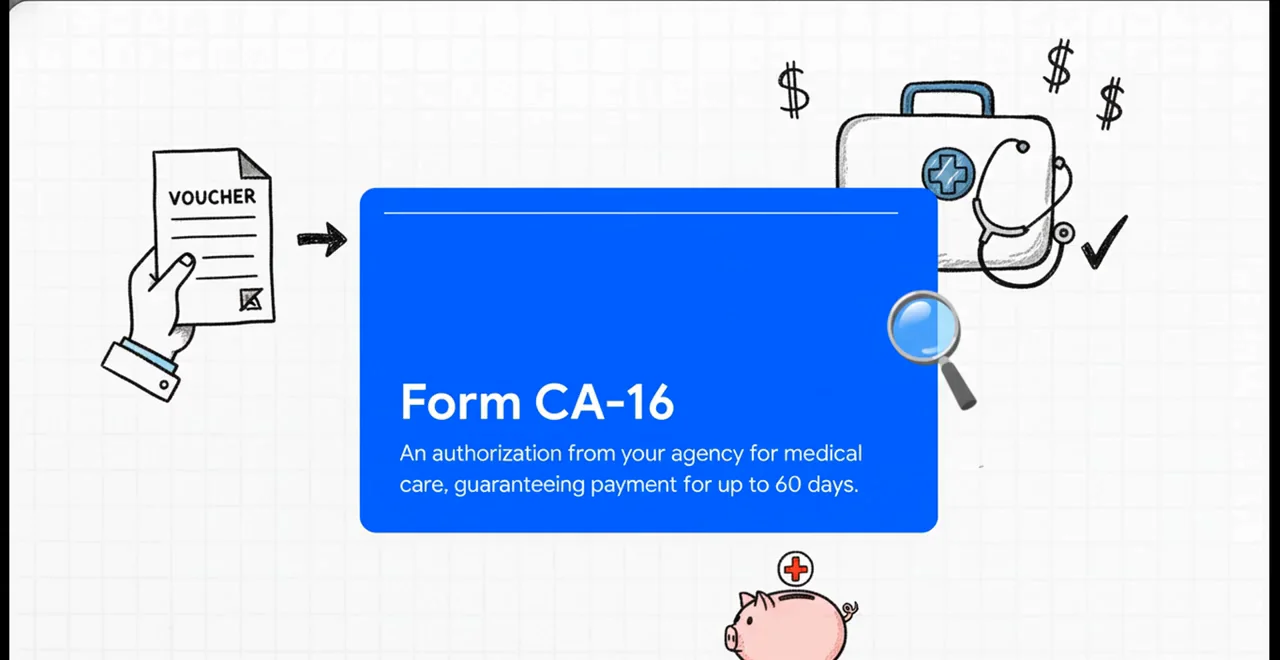
The CA-16 is what keeps the first 60 days off your own insurance.Watch at 3:05 - 7
Hit the 30-day mark and keep continuation of pay
20 CFR 10.205 makes the 30-day deadline a condition of continuation of pay: the CA-1 has to be filed within 30 days of the injury, and you have to begin losing time from work within 45 days of it. The claim itself has a longer deadline — three years from the date of injury under 20 CFR 10.100(b) — but a late CA-1 costs you the pay protection, which is the part most people cannot afford to lose.
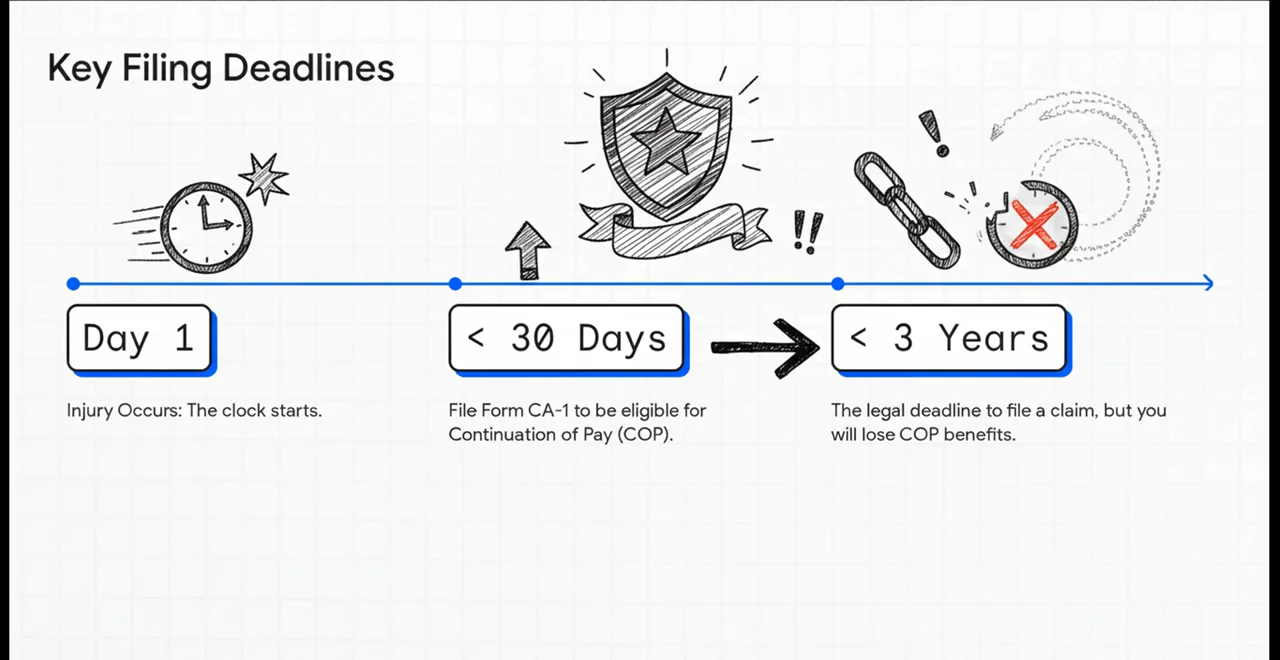
Thirty days is not the claim deadline — it is the pay deadline.Watch at 2:12 - 8
Continuation of pay: up to 45 calendar days
Continuation of pay is your regular salary for up to 45 calendar days of disability after a traumatic injury, paid by the agency rather than by OWCP. It is taxable and carries your normal deductions, and it is neither sick leave nor annual leave — your balances stay intact. If you are still disabled beyond that window, wage-loss compensation continues on Form CA-7.
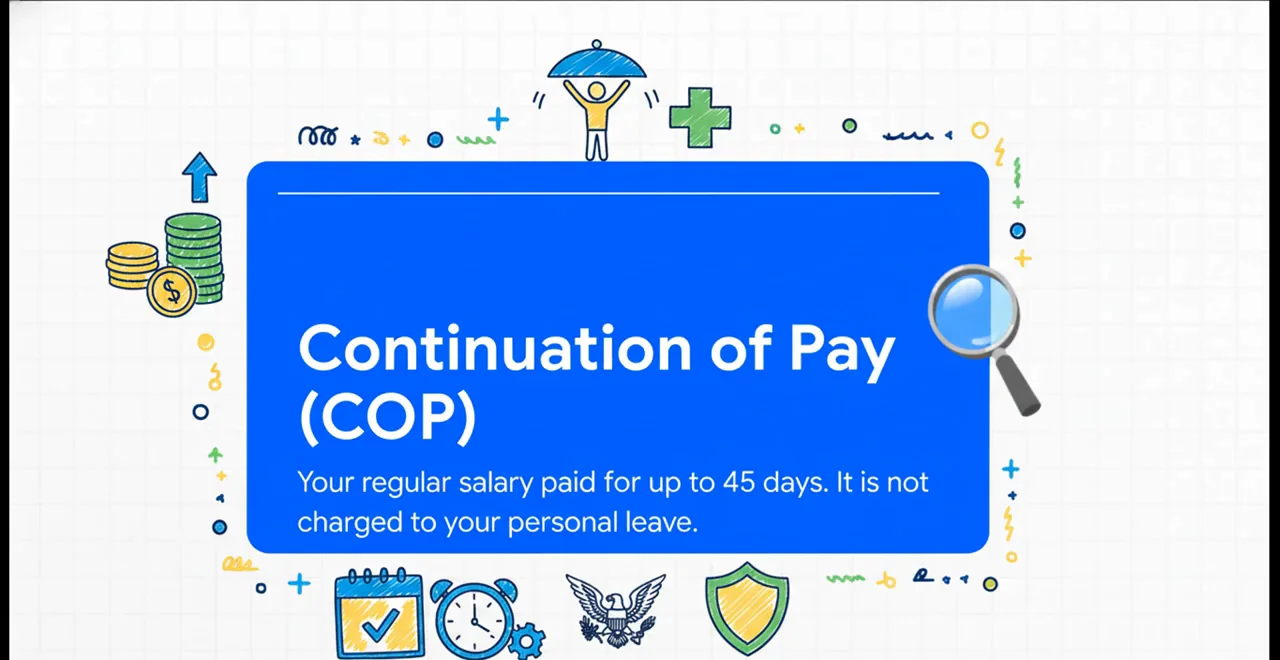
COP keeps your paycheck whole and leaves your leave balances alone.Watch at 2:28 - 9
File it in ECOMP, the Department of Labor system
Federal injury claims are filed online at ecomp.dol.gov. Register or sign in, choose New Claim, then select Form CA-1. The flow runs in five steps: create the claim and pick the form, complete your portion — items 1 through 15 — enter your supervisor’s correct email address, review the form, then sign and submit it electronically. The supervisor email matters, because the system sends the form to them the moment you submit.
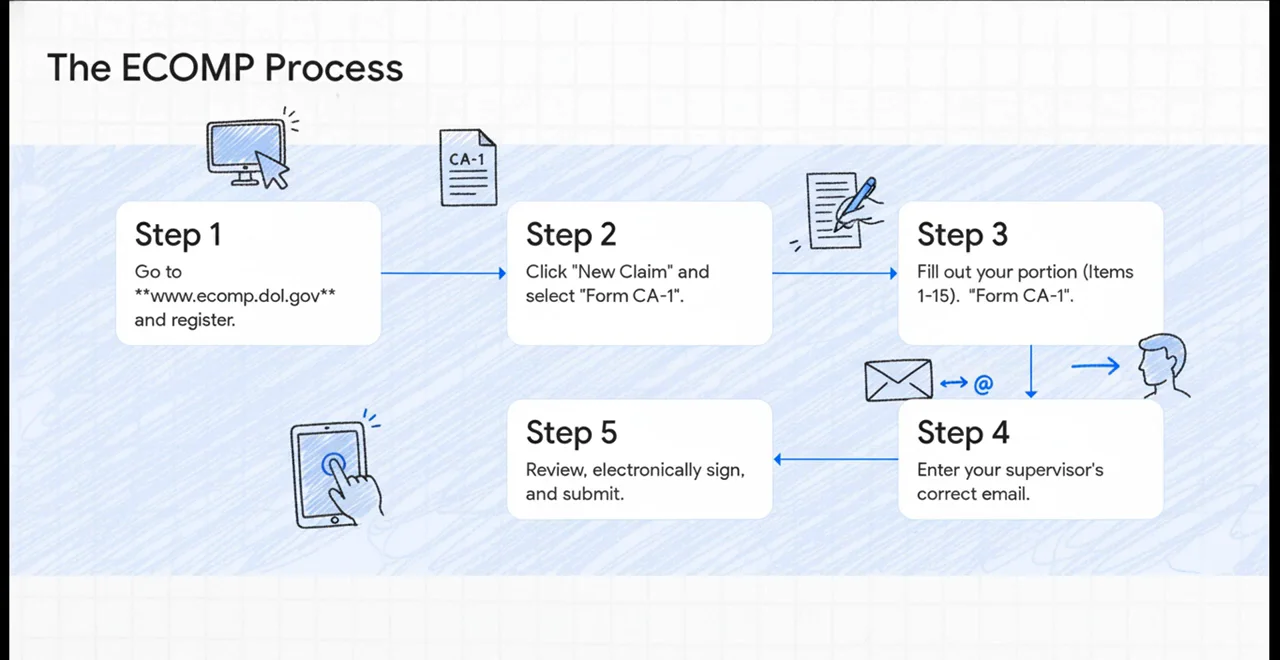
ECOMP is where the CA-1 is actually filed.Watch at 4:18 - 10
Write box 13 like a witness statement
Item 13 asks for the cause of injury — what happened and why. Instead of “hurt my back at work”, give the clock time, the task, the object and the exact sensation: “At about 2:15 p.m., while lifting a 45-pound box from the floor to a shelf, I felt immediate sharp pain in my lower back.” Item 14 asks you to identify the injured body part, and box 13 is where causation is either visible on the page or missing from it.
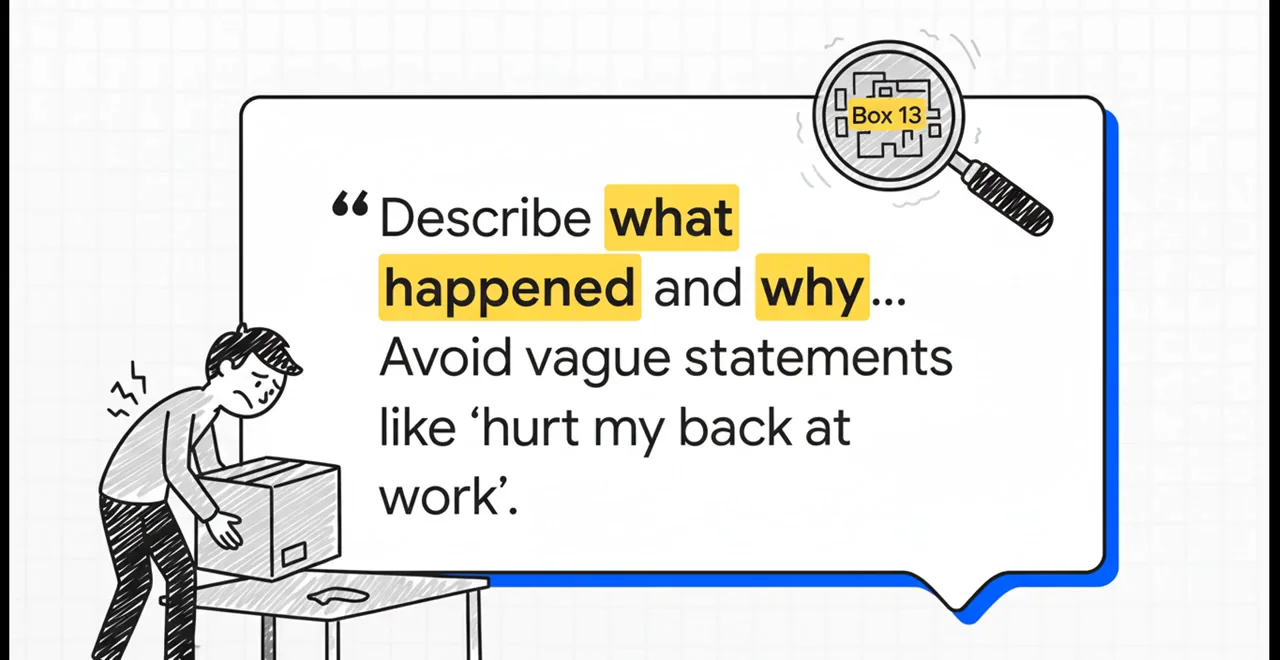
Precision in box 13 is evidence you never have to argue about later.Watch at 5:05 - 11
Get the medical evidence in within 10 calendar days
Filing the CA-1 is only half of the continuation-of-pay application. 20 CFR 10.210(b) requires medical evidence supporting the disability — including a statement of when you can return to your date-of-injury job — to be provided to the employer within 10 calendar days after you file the claim for COP. Ask the treating provider for a written report with the diagnosis and the work restrictions on the day you are seen, and keep a copy.

The form gets you in the door; the medical evidence keeps payments running.Watch at 5:27 - 12
Make sure the doctor’s report proves causation
The medical report has to carry five things: a clear diagnosis, the history of the work incident, a medical opinion that the work incident caused the injury (causation), your work limitations, and the signature of a qualified physician. Causation is the piece OWCP cannot supply for you — 20 CFR 10.115(e) puts the burden of proving that link on the claim, and a report that lists a diagnosis without an opinion on causation leaves the gap open.
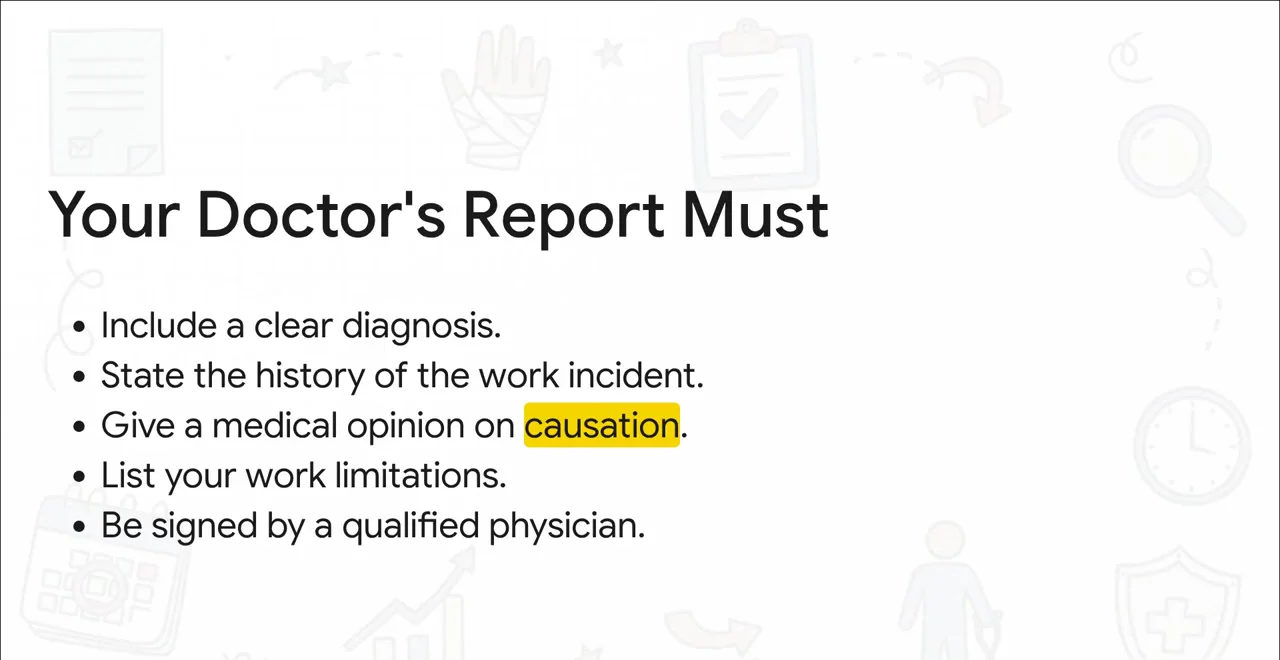
Diagnosis, history, causation, limitations, signature — all five, every time.Watch at 5:42 - 13
Track the case number your agency gets back
Once the agency completes its portion, OWCP assigns an official case number. That number goes on every later form — CA-7 for wage loss, CA-16 requests, medical bills, correspondence — and it is what the claims examiner uses to find your file. Keep copies of everything you submit together with the date you sent it: the CA-1, the CA-16, the medical reports and the receipts.

One case number, used everywhere, answers most follow-up calls.Watch at 6:05 - 14
The do and do-not list for a CA-1 claim
Do report the injury immediately, be specific and detailed, get the medical evidence in on time, and keep copies of everything. Do not wait more than 30 days, be vague about what happened, forget a causation opinion in the medical report, or assume the process runs itself. It is also worth asking your agency for an extra copy of the completed CA-1 — that is the record of what you actually claimed.
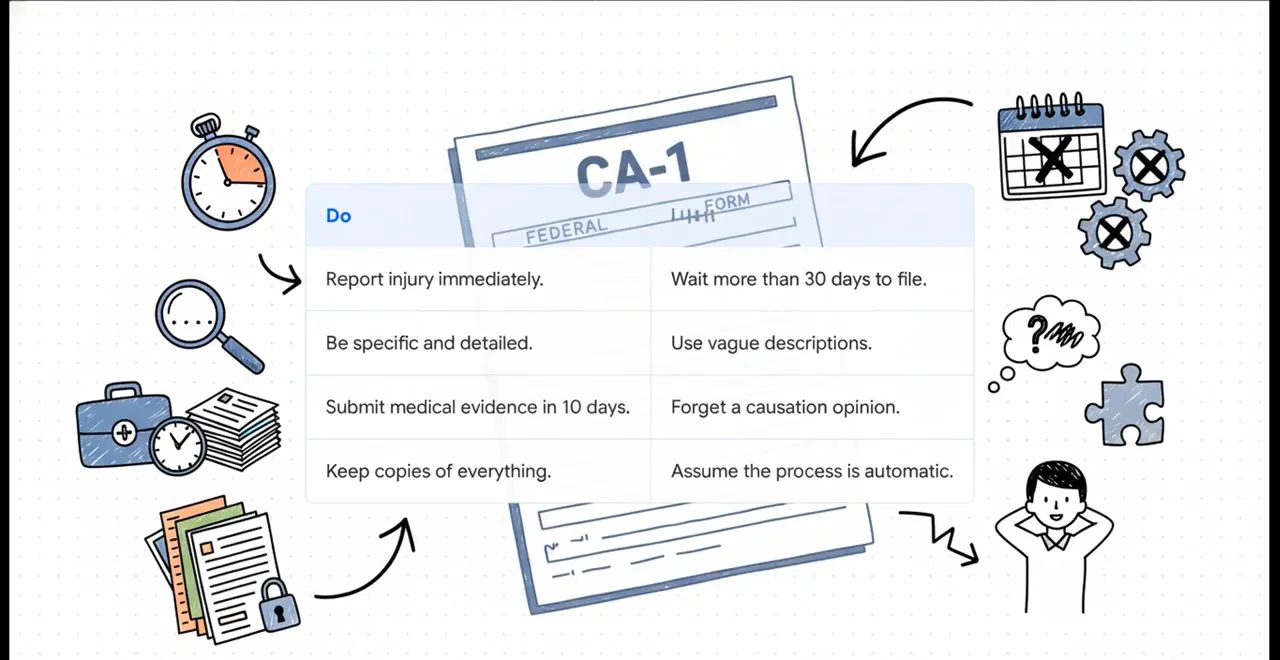
The whole claim on one card: four things to do, four to avoid.Watch at 6:28 - 15
If the 30-day window has already passed
File the CA-1 anyway, and keep the dates straight. Under 20 CFR 10.205 a filing later than 30 days after the injury costs you continuation of pay — but not the claim: the notice of injury can be filed up to three years after it happened (20 CFR 10.100(b)). Even a claim filed after those three years may be allowed if you gave notice within 30 days, or if your employer had actual knowledge of the injury within 30 days, so record who you told and when. Medical bills and wage-loss compensation are decided on the claim, not on the COP clock.
Frequently asked questions
- What is the deadline to file a CA-1?
- There are two deadlines and they do different things. To be eligible for continuation of pay, 20 CFR 10.205 requires you to file Form CA-1 within 30 days of the date of injury, and you must begin losing time from work within 45 days of the injury. The notice of injury itself may be filed up to three years after the injury under 20 CFR 10.100(b). File immediately: the 30-day mark is the one that costs you money when you miss it.
- What is the difference between Form CA-1 and Form CA-2?
- Form CA-1 reports a traumatic injury — a single event in a single work shift, such as a fall, a struck hand or a back that gave out during one lift. Form CA-2 reports an occupational disease, a condition that developed over time from work exposures or repeated stress, such as carpal tunnel syndrome or hearing loss. Filing the wrong form does not create a claim for the other one, so pick the form that matches how the condition actually started.
- Do I have to use my own sick leave while the claim is pending?
- No. Under 20 CFR 10.200 the employer must continue your regular pay during periods of disability from a traumatic injury, up to a maximum of 45 calendar days, and may not require you to use your own sick or annual leave while doing so. Continuation of pay is taxable and carries your normal payroll deductions, but it is not leave — your balances stay intact. If you elected leave instead of COP on the CA-1, § 10.206 lets you change that election.
- What does Form CA-16 actually authorize?
- Form CA-16 is the employer’s authorization for medical examination and treatment, and 20 CFR 10.300 requires the agency to issue it — within four hours of the claimed injury, or within 48 hours if it gave verbal authorization first. It must name the authorized physician or facility, and it authorizes treatment for 60 days from the date of injury unless OWCP terminates the authorization earlier. Ask for it on the same day you report the injury; the agency is not required to issue one more than a week afterwards.
- How fast does the medical evidence have to be submitted?
- For continuation of pay, 20 CFR 10.210(b) requires medical evidence supporting the disability — including a statement of when you can return to your date-of-injury job — to be provided to the employer within 10 calendar days after you file the claim. The report itself has to contain a clear diagnosis, the history of the work incident, a medical opinion that the incident caused the injury, your work limitations and a qualified physician’s signature, and under 20 CFR 10.115(e) the burden of proving causation is on the claim, not on OWCP.
Keep reading
Educational information only, not legal advice. Deadlines and entitlements come from 20 CFR Part 10 and the Department of Labor, and they can change; confirm dates, filing status and payments with your agency’s workers’ compensation office or an attorney.